
Mobile locksmith · Atlanta service-area business
Help with locked doors, worn keys, misaligned deadbolts and security updates for houses, condos, townhomes and apartments.
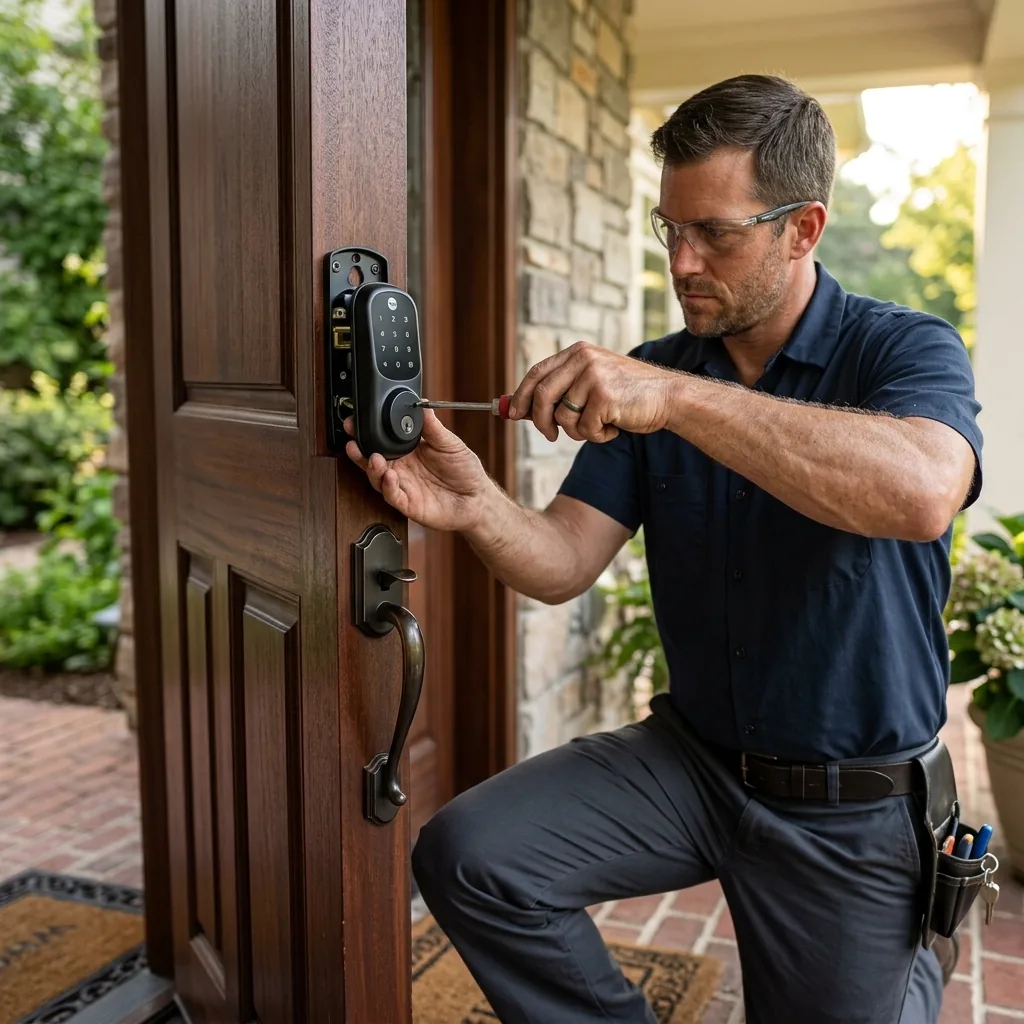
If the door closed behind you or a key no longer works, the technician assesses the lock and uses an entry method suited to the hardware. Once access is restored, the cause of the failure can be checked.
Rekeying changes the internal key combination while keeping compatible lock hardware in place. It is a practical option after moving, tenant turnover or an unreturned key.
Deadbolts, knob locks, lever locks and common residential hardware are all serviceable. Loose cylinders, stiff keys and alignment problems may be repairable; damaged or outdated locks can be replaced.
The door slab, the hinges, the frame, the strike plate, the latch and the deadbolt all move together every time you come and go. When something starts to go wrong, the symptom you feel at the key is often the last link in a chain that began somewhere else. A key that turns stiffly can mean a worn cylinder, or it can mean the door has settled on its hinges and the bolt is now dragging on the strike. Because of that, a residential visit begins with the whole opening rather than with a decision to replace a part.
Fast Locksmith Service works on the hardware found on most Atlanta houses, condominiums, townhomes and apartments: single-cylinder and double-cylinder deadbolts, keyed knobs and levers, handlesets, night latches, and the keypad and connected locks that are now common on newer builds and renovations. The technician inspects how each piece is behaving, explains what is worth repairing, what is better rekeyed, and what has reached the end of a dependable service life, and confirms the work and the cost with you before starting.
If a door has closed behind you or a key has stopped working, the first step is identifying the lock and the door construction so an opening method can be chosen that leaves the hardware intact. Most residential pin-tumbler locks can be opened without damage. Once you are back inside, it is worth a few minutes to work out why the lockout happened, because a self-closing storm door, a worn latch spring or a key that is quietly wearing out will do it again.
Before any entry work, the technician confirms that you own the home, live there, or are authorized to be let in. For an apartment or condominium that can mean a lease, photo identification that matches the address, or a call to a manager. This step is routine and it protects everyone involved.
A key that has started to bend is a warning. Brass wears, and a worn key eventually rounds off its cuts until it no longer lifts the pins correctly. Forcing it is how a key snaps off inside the cylinder and turns a five-minute problem into an extraction. If you have another copy that still works smoothly, compare the two: a visibly worn key can be re-cut from the better original, while two worn copies point to the cylinder itself.
Doors settle with hinge wear, humidity and years of use. A latch that no longer catches, or a deadbolt that needs the door pulled tight before it will turn, is usually an alignment problem. Adjusting the hinges, moving the strike, or enlarging the strike opening brings the bolt back into line. A new lock does not fix a geometry problem, and replacing one before checking alignment is a common and avoidable expense.
When you take possession of a home you receive keys, but you cannot know how many other copies exist. Previous owners, relatives, cleaners, contractors, agents and dog walkers all accumulate keys over the years. Rekeying changes the pin combination inside each lock so only your new keys work, while keeping the lock bodies you already have. When the exterior hardware is in good condition, rekeying every outside door to one new key is usually the most practical first step in a new home.
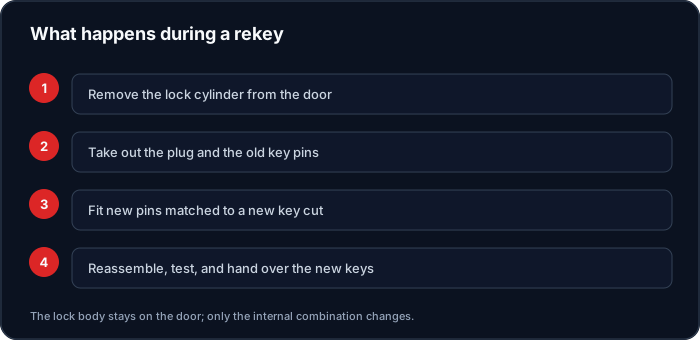
The same approach helps after a lost key, a separation, a departed housemate or a burglary. If the missing key can be connected to your address, rekeying the locks it fits restores control without the cost of new hardware. There is a fuller comparison on the guide, rekey or replace your locks.
Repair corrects a fault in hardware that is otherwise sound: a loose cylinder, a sticking latch, a strike that no longer lines up, a handle that has worked loose. Many of these are quick adjustments once the cause is identified. Rekeying changes who can open a working lock. Replacement makes sense when a lock is physically worn, when the finish and body are damaged, when you are moving from a builder-grade lock to something stronger, or when a door has no deadbolt and you want to add one.
A deadbolt that locks only when you lift or pull the door is almost always an alignment problem, not a failed lock. The fix is usually adjusting the hinges or the strike, which costs far less than a new deadbolt.
A replacement lock has to match the door's thickness, the bore diameter and the backset, which is the distance from the edge of the door to the centre of the bore. Most Atlanta homes use standard dimensions, but older houses and custom doors sometimes do not, which is why measurements are checked before hardware is ordered. Beyond fit, the choice comes down to how your household lives: a keyed deadbolt is simple and needs no power; a keypad lock removes the physical key but depends on code discipline and batteries; a connected lock adds remote control and a log of use, with more to maintain.
Where possible, new cylinders can be keyed to match a key you already carry, so one key operates every exterior door. That is a decision worth making at installation rather than later, when it means another visit. The deadbolt guide covers grades, bolt throw and strike reinforcement in more detail.
Residents should check the lease or the building rules before changing hardware. Management often controls exterior cylinders, common-area doors and any restricted keyway used across the property. Proof of residency or written authorization is required for work on a unit. For a landlord or a property manager, rekeying between tenants is a routine measure that makes the previous occupant's keys stop working on compatible locks; a written door and key schedule keeps units, storage and maintenance access clearly separated. Managed-building work is described further on the commercial locksmith page.
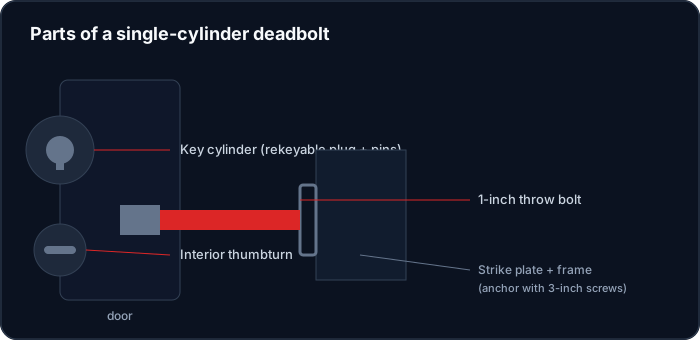
The lock resists picking and the strike resists force, and most residential doors fail at the strike. The factory strike is held by short screws that only bite into the door trim. Replacing them with three-inch screws that reach the wall framing is the single largest resistance gain available for a small cost. Other simple measures include a strike box behind the plate, hinge screws that also reach the framing on out-swing or exposed-hinge doors, and a viewer or sightline so you can see who is at the door before opening it.
You can describe all of this on the contact page or by phone. Coverage across the city is listed on the service areas page.
Some home lock problems are easy to live with until they are not. A key that has to be jiggled, a deadbolt that needs a shoulder against the door, a handle that has started to wobble, a latch that only catches on the second pull: each of these is a small fault that tends to get worse, and each is less expensive to correct early than after the part has failed or the key has snapped. If you have recently moved, if a key has gone missing, or if you have never checked that every exterior door has a working deadbolt, those are all reasons to have the hardware looked at.
A few ideas cause people to spend money in the wrong place. The first is that a hard-to-turn key means a failing lock; often it is a worn key or a door out of alignment. The second is that a smart lock is inherently more secure; it changes how you manage access, not how the door resists force, and the strike is still what matters most there. The third is that rekeying and replacing are interchangeable; they solve different problems, as the guide explains. The fourth is that a deadbolt alone is enough; a one-inch bolt into a strike held by three-quarter-inch screws is only as strong as those screws.
If the work is planned rather than a lockout, a few photographs of the whole door and of both faces of the hardware help the technician arrive with the right parts. Clear the area around each door so the hardware can be removed and refitted. If you want new locks keyed to an existing key, have that key available. If the home is in a managed building, arrange access and, where a shared entrance is involved, management authorization before the appointment.
Fast Locksmith Service travels to the customer and does not run a public walk-in shop, so the first contact is a phone call or the contact form rather than a counter visit. On the call you describe the lock, the door, the key or the vehicle and what changed; coverage is confirmed against your street or nearest intersection; and the likely category of work and the factors affecting its cost are discussed. A firm recommendation and a firm price still depend on the technician seeing the hardware, because the same symptom often has more than one cause.
Every access job requires proof that you own, occupy or are authorized to control the property or vehicle. For a home that is usually identification matching the address; for a rental, a lease or a manager's confirmation; for a business, an authorized contact; for a vehicle, ownership documentation. This is routine, it protects everyone, and a locksmith who is willing to skip it is one to be cautious about.
Wherever the lock allows, it is opened or serviced without damage: picking, bypass tools, and decoding leave the hardware usable afterwards. Drilling is a last resort for a seized or hardened lock, or one that is already broken, and the technician explains that it is next and that the lock will be replaced before doing it.
For planned work, a few photographs of the whole door and both faces of the hardware help the technician arrive prepared, and clearing the space around each door speeds the job. Afterwards, the technician checks that bolts throw fully with the door open and closed, that keys turn without effort, and that strike screws are tight in solid material, and explains anything that may need a further small adjustment as an older door continues to move with the seasons. The client's phone line is listed as open 24 hours, and any pricing is confirmed before work begins.
If the hardware works well and you only need old keys to stop working, rekeying may be enough. Replacement suits damaged hardware or a planned security change.
Often, when the lock cylinders and keyways are compatible. The existing hardware has to be inspected first.
Yes. Permission from the resident, owner or an authorized property representative may be required.
A firm price depends on inspecting the work. The factors that affect it are how many locks or doors are involved, the type and condition of the hardware, whether any parts are needed, and the access at the site. Any pricing is explained on the call in general terms and confirmed before work begins; if an unexpected condition changes the picture once a lock is apart, that is explained before anything else is done.
In most cases, yes, when the hardware is standard and no special-order part is required. Where a part has to be sourced, the technician explains that and arranges a return visit.
Then that is what you are told. If you ask for a rekey but the lock is worn out, or for a replacement when a small adjustment would fix it, the technician explains the difference and the reasoning before any work.
Call and tell us what is happening. The technician reviews the lock, door, key or vehicle and explains the options before any work begins.