
Mobile locksmith · Atlanta service-area business
Diagnosis and repair for sticking, loose, misaligned or damaged locking hardware on homes and businesses.
Doors settle over time with hinge wear and weather. If the key works with the door open but not closed, alignment is often the cause rather than the lock itself.
A key that catches in every position may point to the key or the cylinder. A key that is starting to bend should be taken out of use before it breaks inside the lock.
Loose cylinders, worn springs and damaged strikes are assessed. Where a repair will not last, replacement is explained before any work.
The same few symptoms have several different causes, and guessing wrong means paying for the wrong fix. A key that is hard to turn can be a worn cylinder, a worn key, dirt and dried lubricant, or a bolt binding because the door has moved. A deadbolt that will not throw can be a failed cylinder or, far more often, a strike that no longer lines up. A loose handle can be two screws or a worn spindle. A repair visit starts by working out which of these is actually happening.
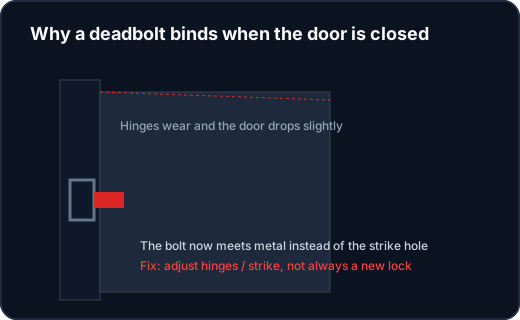
Doors settle. Hinges wear, timber expands and contracts with Atlanta's humidity, and the frame shifts slightly over years of use. The result is a latch that no longer catches, or a deadbolt that needs the door pulled tight before it will turn. The fix is usually adjusting the hinges, the strike position or the strike opening, sometimes with a longer screw into the framing to draw the jamb back into line. A test: if the lock works perfectly with the door open and fails only when it is closed, the problem is alignment, not the lock.
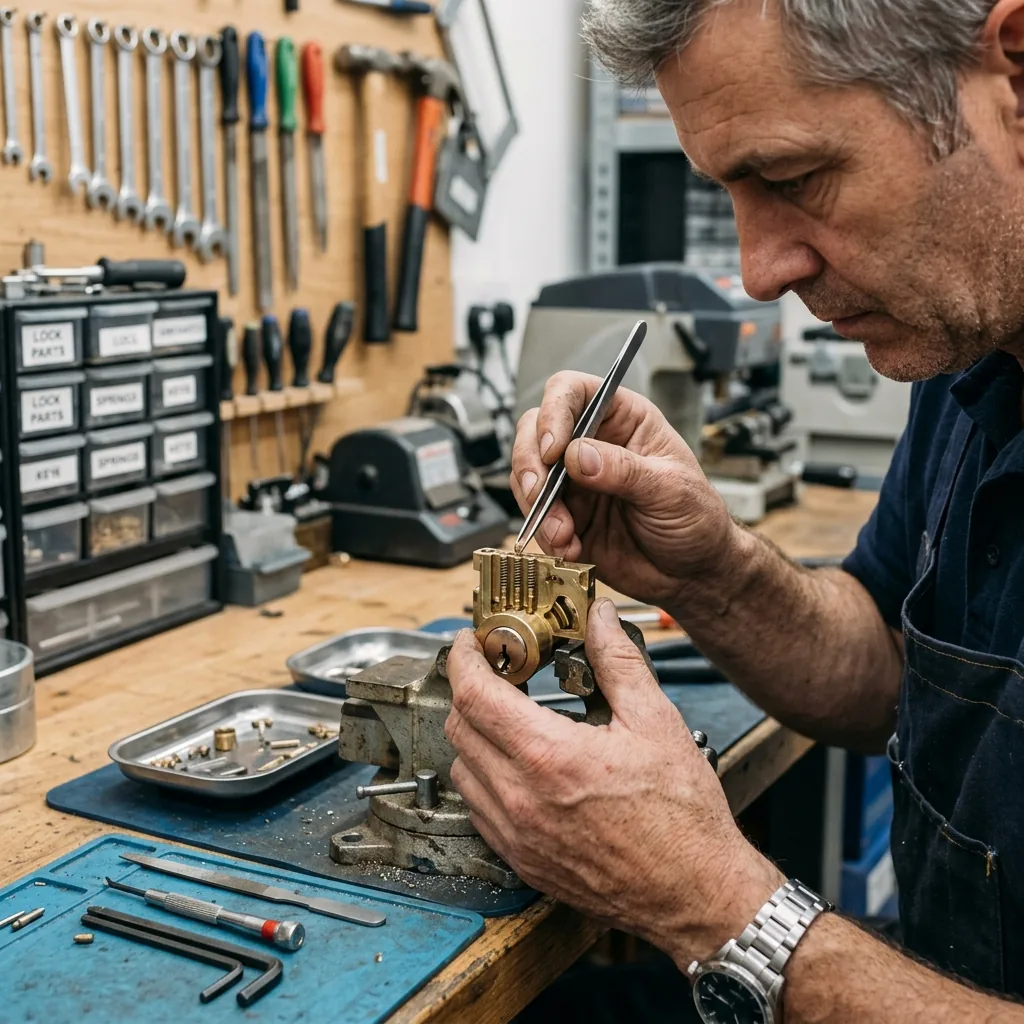
If a key catches in every position, the key or the cylinder needs attention. A worn key can be re-cut from a better original. A cylinder that is gritty can sometimes be cleaned and re-lubricated with a dry lubricant; graphite and household oil tend to make things worse over time by attracting dust and forming a paste. Where the cylinder is worn past a dependable clean-up, it can often be replaced without changing the whole lock, and rekeyed to your existing key at the same time.
Loose cylinders, worn latch springs, a thumbturn that spins without moving the bolt, a lever that droops, a damaged strike: these are common and usually repairable. Some are quick adjustments; some need a part. When a component has genuinely failed and a repair would not last, that is said plainly, with replacement options and costs explained before anything is done.
Repair is not always possible. Some hardware is worn or damaged past a dependable fix, and in that case replacement is the honest recommendation rather than a repair that fails again in a month.
Patio sliders use a hook or mortise latch that engages a keeper in the frame; when the door drops on its rollers, the hook misses the keeper and the door will not lock. Adjusting the rollers and the keeper usually restores it. Gate latches, storm-door locks, mailbox locks and cabinet locks are all serviceable, and are often quicker than they look once the mechanism is identified.
On business doors, basic closer adjustment and strike alignment are part of the work. A closer that slams the door or fails to latch it can often be adjusted at the valves; a closer that is leaking oil or has lost its internal resistance needs replacing. Panic hardware that sticks is inspected against the traffic and any code requirement for that opening, because an exit device has to release reliably under load.
Related pages: rekeying, lock installation and the guide on choosing a deadbolt.
A lock that has become gritty or slow often just needs cleaning and the right lubricant. The wrong products cause more problems than they solve: household oil and spray lubricants attract dust and, over months, form a paste that binds the pins, and powdered graphite can clump if it meets any moisture. A dry PTFE-based lubricant, applied sparingly after the keyway is cleaned, is the usual choice. If a lock does not improve with cleaning and lubrication, the wear is mechanical and a part is needed.
Some hardware can technically be repaired but should not be. A budget lock that has already worn out once will wear out again; a cylinder that is pitted with corrosion will not stay smooth; a lock body with cracked castings is not safe to rely on. In those cases the honest recommendation is replacement, with the reasoning explained, rather than a repair that fails again soon and costs you a second visit.
Once alignment or hardware work is done, the technician checks that the bolt throws fully and freely with the door both open and closed, that the key turns without effort, and that the strike screws are tight in solid material. If the repair was driven by a door that had settled, it is worth knowing that the door may continue to move with the seasons and a further small adjustment could be needed later; that is normal for an older door in Atlanta's climate.
Be ready to say what the lock is doing, whether it behaves differently with the door open versus closed, whether the problem came on suddenly or gradually, and whether there has been any recent work on the door, the frame or the weatherstripping. Say what type of lock it is, knob, lever, deadbolt, mortise, keypad or slider, and whether you would prefer a repair if it is practical or would rather replace the hardware.
Fast Locksmith Service travels to the customer and does not run a public walk-in shop, so the first contact is a phone call or the contact form rather than a counter visit. On the call you describe the lock, the door, the key or the vehicle and what changed; coverage is confirmed against your street or nearest intersection; and the likely category of work and the factors affecting its cost are discussed. A firm recommendation and a firm price still depend on the technician seeing the hardware, because the same symptom often has more than one cause.
Every access job requires proof that you own, occupy or are authorized to control the property or vehicle. For a home that is usually identification matching the address; for a rental, a lease or a manager's confirmation; for a business, an authorized contact; for a vehicle, ownership documentation. This is routine, it protects everyone, and a locksmith who is willing to skip it is one to be cautious about.
Wherever the lock allows, it is opened or serviced without damage: picking, bypass tools, and decoding leave the hardware usable afterwards. Drilling is a last resort for a seized or hardened lock, or one that is already broken, and the technician explains that it is next and that the lock will be replaced before doing it.
For planned work, a few photographs of the whole door and both faces of the hardware help the technician arrive prepared, and clearing the space around each door speeds the job. Afterwards, the technician checks that bolts throw fully with the door open and closed, that keys turn without effort, and that strike screws are tight in solid material, and explains anything that may need a further small adjustment as an older door continues to move with the seasons. The client's phone line is listed as open 24 hours, and any pricing is confirmed before work begins.
Not always. Some hardware is worn past a reliable repair, in which case replacement is the honest recommendation.
That is usually alignment. The door, hinges and strike are checked, not just the lock.
Basic closer adjustment is included in commercial lock work; a failed closer may need replacement.
A firm price depends on inspecting the work. The factors that affect it are how many locks or doors are involved, the type and condition of the hardware, whether any parts are needed, and the access at the site. Any pricing is explained on the call in general terms and confirmed before work begins; if an unexpected condition changes the picture once a lock is apart, that is explained before anything else is done.
In most cases, yes, when the hardware is standard and no special-order part is required. Where a part has to be sourced, the technician explains that and arranges a return visit.
Then that is what you are told. If you ask for a rekey but the lock is worn out, or for a replacement when a small adjustment would fix it, the technician explains the difference and the reasoning before any work.
Call and tell us what is happening. The technician reviews the lock, door, key or vehicle and explains the options before any work begins.