
Mobile locksmith · Atlanta service-area business
Non-destructive entry is the default for a reason. Here is a plain overview of the common methods and why drilling is a last resort.
A lock that is picked or bypassed still works afterward. A lock that is drilled has to be replaced. A responsible technician tries the methods that preserve the hardware first and only escalates when the lock resists or is already damaged.
Most residential pin-tumbler locks can be opened by manipulating the pins to the shear line, either with a pick and tension wrench or with a pick gun. This leaves the lock fully functional.
Some locks can be opened without touching the keyway at all: a shove or loid tool on a spring latch, a thumb-turn tool through a gap, or a specific bypass for a known weak point in a particular lock model.
For some situations a working key can be produced on site by impressioning a blank or by decoding the lock, which is useful when no key exists at all.
A seized cylinder, a hardened high-security lock under time pressure, or a lock that is already broken may leave drilling as the only route. A good technician tells you first and expects to replace the lock afterward.
A lock that is picked or bypassed still works afterward. A lock that is drilled has to be replaced. A locksmith who reaches for the drill first is choosing the method that is fastest for them and most expensive for you. The methods below are, roughly in order, what a technician tries before drilling is even on the table.
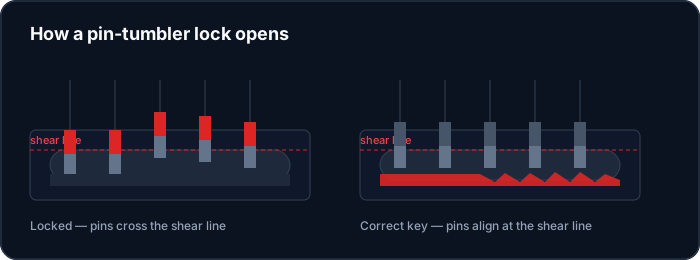
Most residential pin-tumbler locks can be opened by applying light rotational pressure to the plug with a tension tool and then pushing each pin stack up to the shear line, one at a time, with a pick. As each stack reaches the line it stays there, held by the slight rotation, and when the last one is set the plug turns. It is a skill rather than a trick, and on an average builder-grade lock it takes a trained person a short time. Care preserves the existing hardware.
Raking drags a shaped pick quickly across all the pins to bounce them toward the shear line; a pick gun does the same thing mechanically with a snap. Neither is as controlled as single-pin picking, but on simple locks they are quick. Better locks use security pins, spool and serrated shapes, specifically to make raking and pick guns unreliable, which is one of the things you pay for in a higher grade.
Some locks can be opened without touching the keyway at all. A loid or shove tool slips a spring latch that has no deadlocking feature. A thin tool can reach an interior thumbturn through the gap between an in-swing door and the frame. A specific under-door or through-the-gap tool can operate a lever handle on the far side. Many interior doors with a privacy latch open with a small tool pushed into the face hole. And particular lock models have known bypasses that target a weak point in that design.
For some situations the cleanest outcome is a working key. Impressioning clamps a blank in the lock, works it to mark where the pins bind, and files those points until the blank becomes a key. Decoding reads the lock, by disassembly, by a specialised tool, or from a code, and a key is cut to those depths. This is useful when there is no key at all and you want one afterward.
Drilling is the last resort. It is the right call when a cylinder has seized with corrosion or a broken key, when a high-security lock with hardened pins and anti-drill plates will not yield to reasonable effort under time pressure, or when the lock is already broken internally. A responsible technician explains that drilling is next, what it means, and that the lock will be replaced, before doing it. If someone drills a standard residential lock as a first move, that is a sign to ask questions.
The practical takeaway for a homeowner: fit locks with security pins and a deadlocking latch, and actually throw the deadbolt. Most of the quick non-destructive methods depend on the lock being basic or the deadbolt being left unthrown.
Related pages: lockout service and lock installation.
Security ratings exist partly to describe how well a lock resists exactly the techniques above. Higher-grade cylinders use security pins, spool, serrated and mushroom shapes, that give false feedback during picking and make raking and pick guns unreliable. Better locks also add a deadlocking latch that cannot be slipped, anti-drill pins and plates, and a cylinder guard against wrenching. When a locksmith says a lock "took a while", that resistance is usually the reason, and it is the same resistance that works against an intruder.
You do not need a safe-deposit vault on a house door, but a few features close the easy routes: a deadbolt with a one-inch bolt and a deadlocking latch on the knob or lever, a cylinder with security pins, and a strike anchored with three-inch screws into the framing. That combination defeats the quick bypasses and the casual pick and forces anyone, locksmith or not, into slower, louder, more visible methods.
Recreational lock picking is legal in most of the United States when you own the lock, and it has made the general public far better informed about which locks are weak. The practical takeaway for a homeowner is not alarm but specifics: the locks that hobbyists open in seconds on video are almost always basic, and the same brands sell higher-grade lines that hold up far better. Ask for the grade when you buy.
A locksmith who defaults to non-destructive entry, explains the method, and only drills as a stated last resort is working in your interest. One who drills a standard lock as a first move is choosing speed for themselves over cost for you. It is a fair question to ask on the phone: how will you open it, and what happens to the lock afterward.
Reading about picking, bumping and bypass tools can make a house feel wide open. It is worth keeping perspective: the large majority of break-ins are quick and forceful, through a door that was not deadbolted or a window, not the work of someone quietly manipulating a cylinder. The techniques on this page matter mostly because the same lock features that resist them, security pins, a deadlocking latch, a reinforced strike, also make the fast forceful attack harder. Fixing the basics covers both.
A bump key is a key cut to the lowest depth at every position; tapped sharply while under slight turning pressure, it can bounce the pins of a basic pin-tumbler lock to the shear line. It sounds alarming, but the defences are ordinary: security pins make bumping unreliable, and a thrown deadbolt with no give simply does not respond to it the way a loose latch does. This is one more reason the single most effective free habit is to throw the deadbolt, not just pull the door shut.
On screen, a character rakes a lock for two seconds and the door swings open. In practice, single-pin picking is a patient, tactile process of finding which pin is binding, setting it, and moving to the next, and it gets slower as the lock gets better. Raking and pick guns are faster but far less reliable, and security pins are specifically designed to defeat them by giving false feedback. The realistic picture is that a basic lock yields in a short time to someone trained, a good lock takes real effort, and a high-security lock may not yield at all without drilling. That spread is exactly what the grade of the lock is describing.
A few signs separate a straightforward local locksmith from an operation to avoid. A fair locksmith gives you a general idea of pricing on the phone and a firm price to agree before starting work, rather than a low number that climbs sharply once someone arrives. They confirm your authorization to request the work. They default to opening a lock without damage and treat drilling as a stated last resort on a standard residential lock, not a first move. They recommend the work the hardware actually needs, which sometimes means talking you out of a replacement you asked for.
It is reasonable to ask, on the call: how will you open it, roughly what will it cost, and what happens to the lock afterward. The answers tell you most of what you need to know. A business with a real local service area, a published phone number and pages that explain how the work is done, rather than a wall of city names and superlatives, is generally a safer choice than a listing that exists only to capture a search.
If you are weighing a decision rather than dealing with a lockout, describe your specific situation on the contact page or by phone first. The likely answer is usually clear before anyone is on site, and it is confirmed once the hardware is inspected.
Call and tell us what is happening. The technician reviews the lock, door, key or vehicle and explains the options before any work begins.