
Mobile locksmith · Atlanta service-area business
Help with keys locked inside, broken keys, replacement car keys and ignition-related problems. The year, make and model determine the key system.
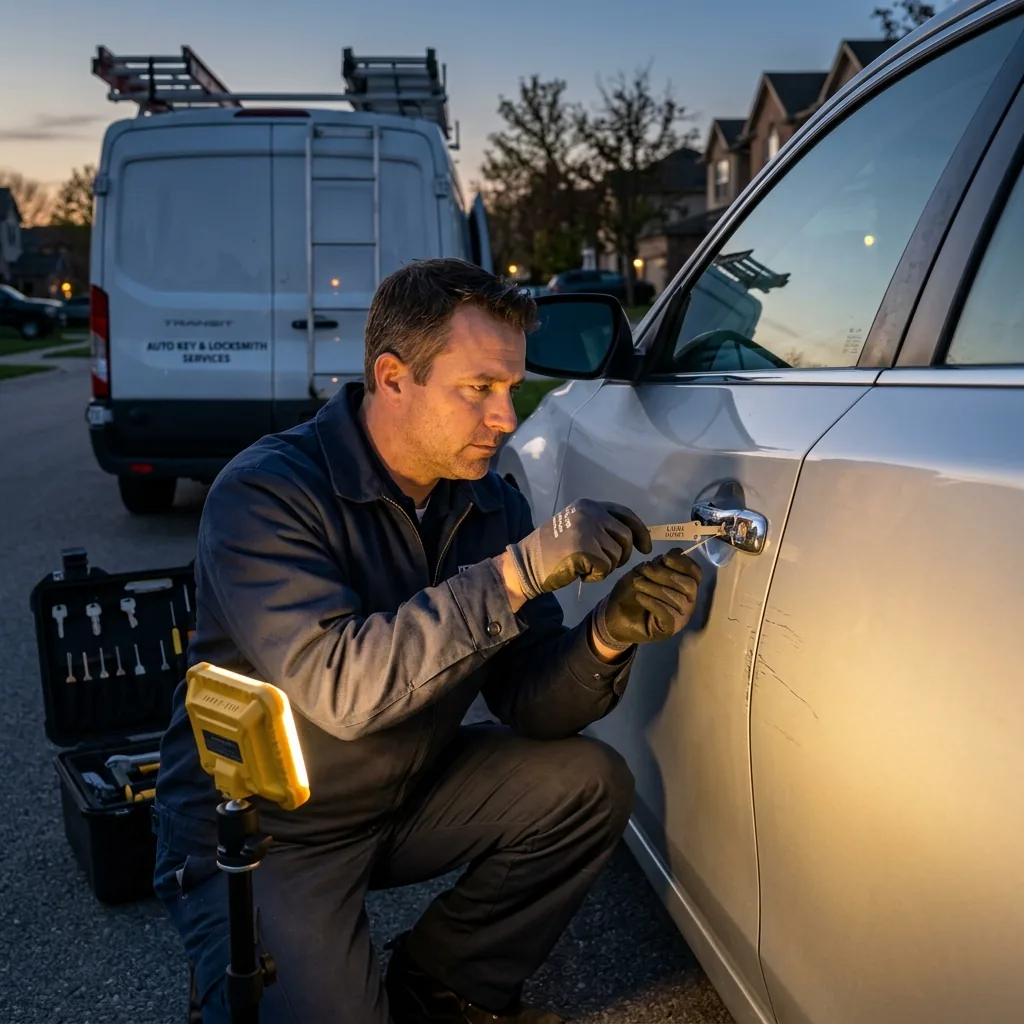
The technician identifies the door and lock type and uses an opening method appropriate for the vehicle. Proof of ownership is required before any work.
Modern keys may combine a blade, a transponder, remote buttons and proximity functions. Replacement depends on the vehicle and the key type, which is confirmed before work starts.
A key that will not turn, or turns intermittently, can point to the key, the cylinder or the vehicle. The likely cause is explained before a repair is recommended.
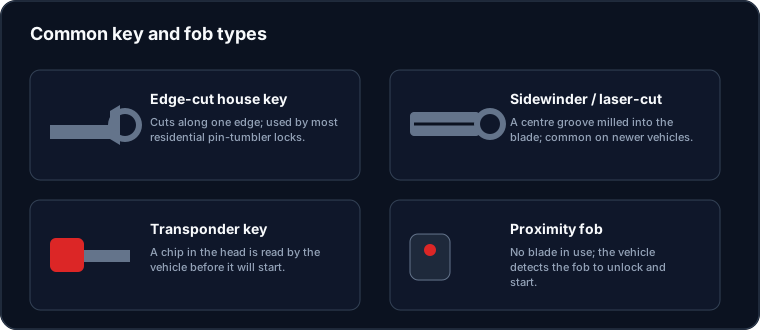
Car keys have changed more in the last two decades than in the previous fifty years. A key might be a simple edge-cut blade, a sidewinder blade with a groove milled down the centre, a transponder key with a chip the car reads before it will start, a switchblade key that folds into a fob, or a proximity fob with no working blade at all. Which one your vehicle uses, and whether a replacement can be produced and programmed away from a dealer, depends entirely on the year, make and model. That is the first thing confirmed on the call.
Fast Locksmith Service helps with vehicle lockouts, lost and broken keys, spare keys and ignition concerns. Proof that you own or are authorized to use the vehicle is required for all key work, and often for a lockout as well.
For a lockout, the technician identifies the door and lock type and uses an opening method suited to that vehicle. Modern cars have layers of trim, wiring, side-curtain airbags and sensors close to the door skin, so the method is chosen carefully to avoid damage. Older vehicles with exposed rods and simple linkages are usually quick. Newer vehicles with electronic latches and reinforced doors take more care and the right tools for that model.
If a child or a pet is shut inside and the situation is becoming unsafe, call 911 first. A locksmith is the right call for an ordinary lockout, not for a situation that has become a situation where minutes matter.
If a key has snapped, the broken part is extracted and the lock or ignition is checked to confirm it still works. If a key is lost, a replacement is cut and, where the vehicle uses a transponder or a fob, programmed to the car so the immobiliser recognises it. Producing a key when no original exists is possible for many vehicles by reading the lock or the vehicle data, and dealer-only for some. This is confirmed before a visit rather than discovered during one.
A single working key is a single point of failure. Having a spare cut and programmed while you still have a working original is far simpler and less costly than starting from no key at all, which for some vehicles means a tow to a dealer.
Most vehicles built since the late 1990s have an immobiliser: a chip in the key exchanges a code with the car, and the engine will not run without it. A key cut to the right blade but with no chip, or the wrong chip, will turn the ignition but not start the car. Programming a new transponder key means adding its code to the vehicle, which for many models can be done on site with the correct equipment and, often, proof of ownership entered into the process.
A key that will not turn in the ignition, or turns only sometimes, can be the key, the ignition lock cylinder, or something in the vehicle beyond the lock, such as a steering lock or a shifter interlock. The technician checks the straightforward causes first: a worn key, debris in the cylinder, or a steering wheel under load binding the lock. Turning the wheel gently side to side while easing the key often frees a bound steering lock. If the cylinder itself has failed, replacement is explained before it is recommended.
For a parking deck, note the deck, level and any security procedure. Coverage is on the service areas page, and related work is described under key replacement and lockout service.
For a modern vehicle the process is usually: confirm the year, make and model and the key type; cut a blade to match the vehicle's lock, either from a code or by reading a door lock; and then program the key or fob to the vehicle so the immobiliser accepts it. Programming adds the new key's identity to the car's list of accepted keys, and for some vehicles it also removes previously programmed keys from that list, which is useful when a key is lost rather than just broken. Proof of ownership is part of this, not an afterthought.
If you break a key but still have another that works, a locksmith can often duplicate and program a replacement quickly. If every key is lost, the vehicle has to be accessed, a key produced from scratch, and the immobiliser taught the new key, sometimes with a security delay built into the car's own procedure. That is why keeping a spare while you still have a working original is worth the small cost; it keeps you out of the more involved process.
Remote-start systems, aftermarket alarms and older immobiliser add-ons can complicate key and lockout work, because they interpose their own electronics between the key and the car. If your vehicle has any of this fitted, mention it on the call. It does not necessarily prevent the work, but it changes the approach and the time involved.
Fast Locksmith Service travels to the customer and does not run a public walk-in shop, so the first contact is a phone call or the contact form rather than a counter visit. On the call you describe the lock, the door, the key or the vehicle and what changed; coverage is confirmed against your street or nearest intersection; and the likely category of work and the factors affecting its cost are discussed. A firm recommendation and a firm price still depend on the technician seeing the hardware, because the same symptom often has more than one cause.
Every access job requires proof that you own, occupy or are authorized to control the property or vehicle. For a home that is usually identification matching the address; for a rental, a lease or a manager's confirmation; for a business, an authorized contact; for a vehicle, ownership documentation. This is routine, it protects everyone, and a locksmith who is willing to skip it is one to be cautious about.
Wherever the lock allows, it is opened or serviced without damage: picking, bypass tools, and decoding leave the hardware usable afterwards. Drilling is a last resort for a seized or hardened lock, or one that is already broken, and the technician explains that it is next and that the lock will be replaced before doing it.
For planned work, a few photographs of the whole door and both faces of the hardware help the technician arrive prepared, and clearing the space around each door speeds the job. Afterwards, the technician checks that bolts throw fully with the door open and closed, that keys turn without effort, and that strike screws are tight in solid material, and explains anything that may need a further small adjustment as an older door continues to move with the seasons. The client's phone line is listed as open 24 hours, and any pricing is confirmed before work begins.
The year, make and model, and proof that you own or are authorized to use the vehicle.
In many cases, yes. It depends on the vehicle and the key system, which is confirmed by phone.
Many proximity systems are supported. Availability is confirmed against the specific year, make and model.
A firm price depends on inspecting the work. The factors that affect it are how many locks or doors are involved, the type and condition of the hardware, whether any parts are needed, and the access at the site. Any pricing is explained on the call in general terms and confirmed before work begins; if an unexpected condition changes the picture once a lock is apart, that is explained before anything else is done.
In most cases, yes, when the hardware is standard and no special-order part is required. Where a part has to be sourced, the technician explains that and arranges a return visit.
Then that is what you are told. If you ask for a rekey but the lock is worn out, or for a replacement when a small adjustment would fix it, the technician explains the difference and the reasoning before any work.
Call and tell us what is happening. The technician reviews the lock, door, key or vehicle and explains the options before any work begins.