
Mobile locksmith · Atlanta service-area business
Removal of old hardware and installation of a new lock sized to the door and matched to how the entrance is used.
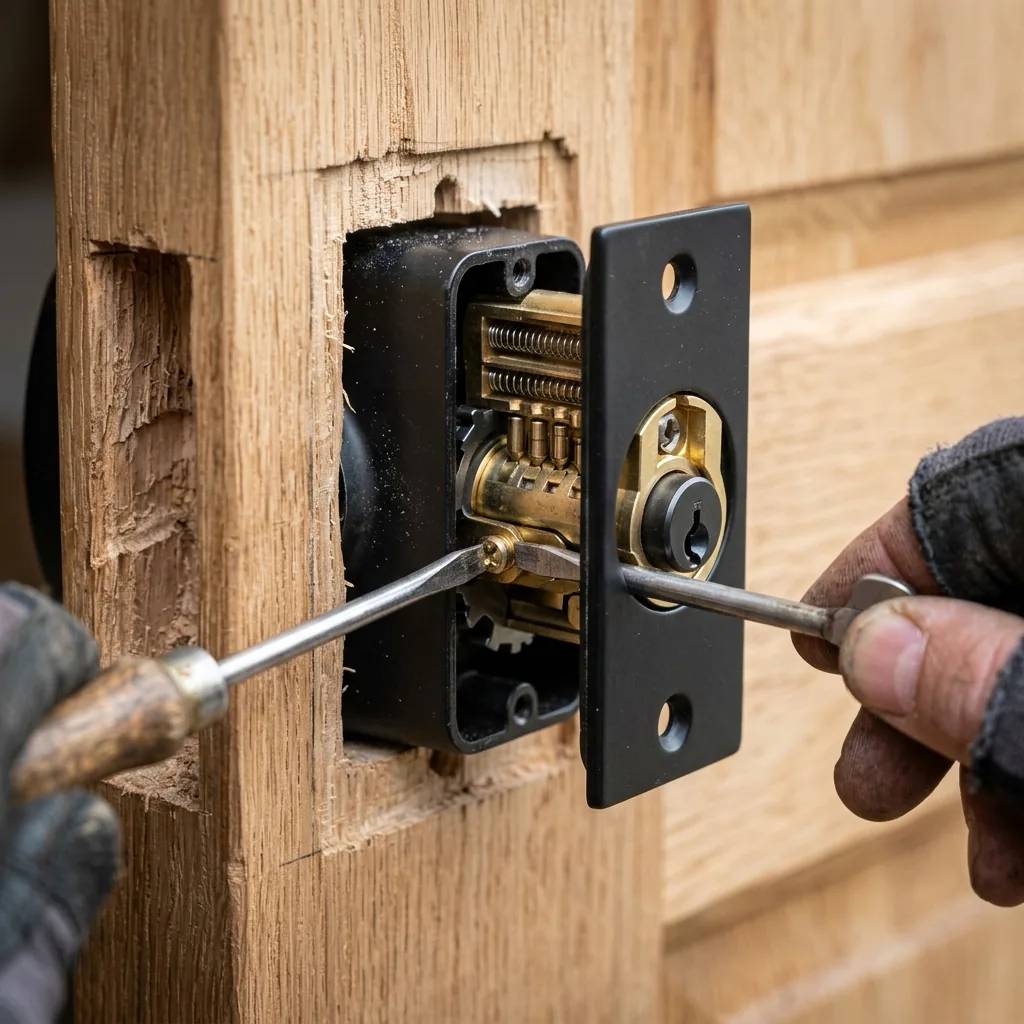
A lock has to fit the door thickness, backset and existing preparation. It also has to match the household or business: keypad locks need code and battery management, keyed locks need control of physical copies.
Single-cylinder deadbolts, handlesets and lever locks are fitted and adjusted so the bolt throws cleanly into the strike.
Where a keypad or smart lock is requested, the technician confirms it fits the door and explains code management before installing it.
A lock that does not fit the door will never work well, no matter how good it is. Installation starts by checking the door thickness, the bore diameter, the backset and the existing preparation. Most Atlanta homes use standard dimensions, but older houses, solid-timber doors and anything custom sometimes do not, and a mismatch is far less expensive to catch before the hardware is ordered than after it is on the door.
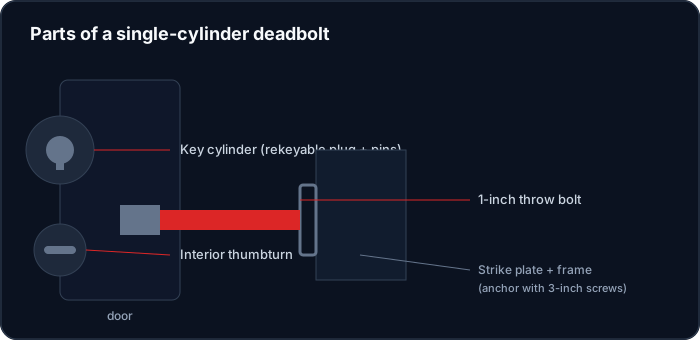
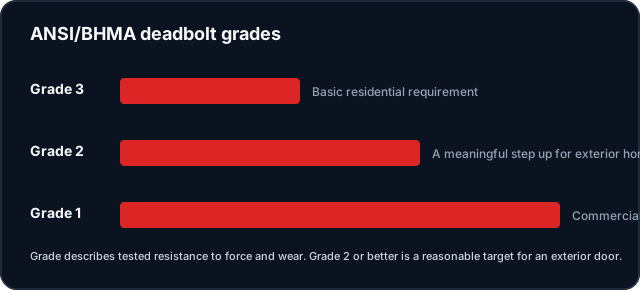
Single-cylinder deadbolts, handlesets and keyed levers are fitted and then adjusted so the bolt throws its full length into the strike without being forced. A deadbolt that only half-throws is barely better than a latch. Where a door has no deadbolt at all, one can usually be added if the door and frame can take the preparation, which is checked first. On a glazed door, a double-cylinder deadbolt removes the risk of an intruder reaching a thumbturn through broken glass, but it also means a key is needed to get out; that trade-off is discussed rather than decided for you, and local code should be considered.
Keypad locks remove the physical key but add code management and batteries to your routine. Connected locks add app control, temporary codes and a log of who came and went, with firmware and often a hub to keep working. Neither is better or worse than a keyed lock; they suit different households. The technician confirms the model fits your door, explains what maintaining it involves, and sets it up if you decide to go ahead.
A connected lock is only as reliable as its batteries and its network. Many people fit a connected lock on the everyday door and keep a plain keyed deadbolt on a second door as a fallback.
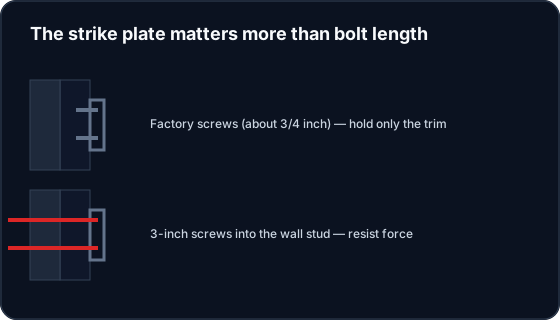
The lock resists picking and the strike resists force, and most doors fail at the strike. The factory strike is held by short screws that only bite into the door trim. Replacing them with three-inch screws that reach the wall framing is the single largest resistance gain available for a small cost, and it is done as part of installation wherever the frame allows. A strike box behind the plate spreads the load further.
When several locks are installed or replaced at once, the new cylinders can usually be keyed alike so a single key opens every exterior door. New cylinders can also often be matched to a key you already carry. This is a decision to make at installation; changing it later means another visit and, sometimes, new cylinders.
Related pages: lock repair, rekeying and the deadbolt guide.
When you replace one lock it is worth thinking about the others. Keying every exterior door alike so a single key runs the house is a small addition at installation and a separate visit later. Matching finishes and handing (which way the door swings) keeps the look consistent. And if some doors are staying and others are being replaced, the technician can often rekey the ones that stay so the whole house shares one key rather than leaving you with two.
Builder-grade locks fitted during construction are chosen for cost, and they are frequently installed with the short screws from the box and the bolt not fully adjusted. Replacing or upgrading them, reinforcing the strikes, and checking the throw is a common first job in a newly built or renovated home. A new addition's exterior door is almost always on its own key and can be brought onto the main house key at the same time.
A new lock on a door that is out of square, hung on worn hinges, or set in a frame that has moved will have the same binding problems the old one did. If the inspection shows a door or frame issue, that is addressed first, as repair work, so the new hardware operates the way it should from the start.
Know which doors are involved and what hardware is on them now, whether you want keyed, keypad or connected locks, whether new locks should match a key you already carry, the door material and age, and whether you are adding a lock where there is none. If you are supplying the hardware, have it available; if you want options discussed, the technician can bring choices to look at.
New deadbolts and entry hardware are fitted to match the door's thickness, bore and backset, adjusted so the bolt throws fully, and set into a strike reinforced with long screws into the framing. New cylinders can usually be keyed alike, or matched to a key you already carry, if that is decided at installation. A door that has settled is realigned first so the new lock works properly from the start.
Fast Locksmith Service travels to the customer and does not run a public walk-in shop, so the first contact is a phone call or the contact form rather than a counter visit. On the call you describe the lock, the door, the key or the vehicle and what changed; coverage is confirmed against your street or nearest intersection; and the likely category of work and the factors affecting its cost are discussed. A firm recommendation and a firm price still depend on the technician seeing the hardware, because the same symptom often has more than one cause.
Every access job requires proof that you own, occupy or are authorized to control the property or vehicle. For a home that is usually identification matching the address; for a rental, a lease or a manager's confirmation; for a business, an authorized contact; for a vehicle, ownership documentation. This is routine, it protects everyone, and a locksmith who is willing to skip it is one to be cautious about.
Wherever the lock allows, it is opened or serviced without damage: picking, bypass tools, and decoding leave the hardware usable afterwards. Drilling is a last resort for a seized or hardened lock, or one that is already broken, and the technician explains that it is next and that the lock will be replaced before doing it.
For planned work, a few photographs of the whole door and both faces of the hardware help the technician arrive prepared, and clearing the space around each door speeds the job. Afterwards, the technician checks that bolts throw fully with the door open and closed, that keys turn without effort, and that strike screws are tight in solid material, and explains anything that may need a further small adjustment as an older door continues to move with the seasons. The client's phone line is listed as open 24 hours, and any pricing is confirmed before work begins.
Often, when the new cylinders are compatible with your keyway. This is confirmed before ordering hardware.
Options are discussed by phone. You can also supply your own hardware for installation.
Usually, if the door and frame can take the preparation. The door is checked first.
A firm price depends on inspecting the work. The factors that affect it are how many locks or doors are involved, the type and condition of the hardware, whether any parts are needed, and the access at the site. Any pricing is explained on the call in general terms and confirmed before work begins; if an unexpected condition changes the picture once a lock is apart, that is explained before anything else is done.
In most cases, yes, when the hardware is standard and no special-order part is required. Where a part has to be sourced, the technician explains that and arranges a return visit.
Then that is what you are told. If you ask for a rekey but the lock is worn out, or for a replacement when a small adjustment would fix it, the technician explains the difference and the reasoning before any work.
Call and tell us what is happening. The technician reviews the lock, door, key or vehicle and explains the options before any work begins.