
Mobile locksmith · Atlanta service-area business
Mobile locksmith service for homes, businesses and cars in Downtown and the surrounding Atlanta area.
Downtown Atlanta is dense with offices, hotels, lofts and ground-floor retail. Access frequently runs through a front desk or security office, so identify an authorized contact before work on a unit door, suite or shared entrance.
Fast Locksmith Service works throughout Downtown for homes, businesses and cars. The technician reviews the lock, door, key or vehicle, explains the options, and confirms the work before starting. Access work requires proof of ownership, residency or authorization.
Identify the affected entrance and any gate instructions. Mention whether the door is older, recently replaced, swollen, damaged or fitted with electronic hardware.
Front-desk approval, parking and elevator coordination may be required. Work on a common entrance usually needs building-management authorization.
Provide the business name and an authorized contact, and say whether the problem affects entry, closing security or an interior restricted area.
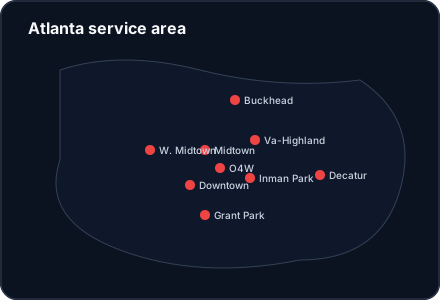
Downtown boundaries overlap in everyday use, and mailing cities can differ from the way residents describe an area. A street or nearest intersection is the best way to confirm coverage. This page describes a general area and does not promise availability at every address.
Downtown Atlanta is offices, hotels, government buildings, converted loft residences and ground-floor retail, packed into a compact grid south of North Avenue. Residential work here is mostly in the loft conversions around Fairlie-Poplar, Peachtree Center and the Castleberry Hill edge, where century-old commercial buildings have been turned into apartments with a wide range of door hardware. Commercial work is storefronts, suites and shared building entrances.
Most Downtown buildings run access through a front desk, a security office or a management company. For a residential loft, identification matching the address usually clears a unit-door job. For anything touching a shared entrance, a lobby door, a parking gate or a mailroom, an authorized building contact needs to approve it. It is worth making that call before the visit so the technician is not held at the desk.
Loft residences: heavy original doors with mortise locks, freight-style doors retrofitted for residential use, and deadbolts on steel doors that have shifted in old masonry openings. Retail and offices: aluminium storefront doors with narrow-stile cylinders, hook bolts and deadlatches, overhead concealed closers, and pivot hinges that wear and drop the door. Shared entrances: rekeying after a tenant moves out and repairing closers so fire and exit doors latch as they should.
A Downtown storefront lock that has become stiff or will not engage is often a door that has sagged on its pivots rather than a failed lock. The pivot and the alignment are checked first; replacing the cylinder on a door that is out of square does not solve it.
The most common residential request in any Atlanta neighbourhood is a rekey after a purchase or the start of a lease. You are given keys at closing or move-in, but there is no way to know how many other copies exist or who kept them over the years. When the existing deadbolts and entry locks are sound, rekeying every exterior lock to a single new key is a contained job that resets that completely, usually in one visit. If one of the locks is already stiff, loose or clearly old, that is the one to replace at the same time rather than rekeying hardware that is near the end of its life. The rekey or replace guide walks through how to tell the difference.
Wood doors and frames move with humidity, and Downtown has plenty of both seasonal swing and, in its older houses, decades of settling. A door that locked cleanly in winter can bind in an August afternoon, and a deadbolt that needs the door lifted or pulled tight is almost always telling you the bolt no longer lines up with the strike. The fix is adjusting the hinges, the strike position or the strike opening, sometimes with a long screw into the framing to draw the jamb back true, rather than a new lock. If the key turns perfectly with the door open and only fails when it is shut, that is alignment every time.
Two small measures prevent a large share of lockouts and break-ins. The first is a spare key held off-site with someone you trust, arranged before you ever need it; a spare in a neighbour's drawer has resolved countless lockouts for the price of cutting one key. The second is making sure every exterior door, not just the front, has a deadbolt that throws its full length into a reinforced strike. A house is only as secure as its weakest door, and side, basement, garage-entry and patio doors are often much weaker than the front.
If a door or window has been forced, photograph the damage before anything is moved and file a police report so there is a record for any insurance claim. Then the priority is making the property secure again: a forced door often needs the frame and strike rebuilt as well as the lock, and any lock a lost or copied key might fit should be rekeyed rather than simply re-keyed to a fresh copy. Some of this can be handled as a temporary measure and finished properly the next day. Cutting another copy of a missing key does nothing, because the missing key still works; changing the combination is what makes it useless.
A resident can authorize work on their own unit door with identification or a lease. Anything that touches a shared entrance, a lobby door, a parking gate, a mailroom or a package room belongs to the association or the management company, and that office has to approve it. Many buildings also keep exterior and common-area doors on a restricted keyway and ask that a copy of any new unit key be filed with management. Making the authorization call before the visit is the single best way to avoid the technician being held at the front desk.
Automotive calls in the neighbourhood are lockouts, replacement keys and fobs, broken keys and ignition concerns. What is possible depends entirely on the vehicle's year, make and model, which is why that is the first thing confirmed on the call. Older vehicles often take a simple cut key; newer ones need a transponder key programmed to the immobiliser or a proximity fob paired to the car, and a few are dealer-only. Proof that you own or are authorized to use the vehicle is required. If the car is in a parking deck, note the deck, the level and any security procedure so the technician can reach it. The car locksmith page has the detail.
Commercial calls here are usually rekeying after a staff change, repairing a door closer or a storefront lock, and organising keys so the right people reach the right doors. An authorized contact should be available to approve access and any hardware change, and any door that is fire-rated or on an accessible route is handled with hardware that keeps that rating. A written key schedule, updated each time a change is made, is what keeps a small business's keys under control over the years. The commercial locksmith page covers this in full.
Fast Locksmith Service is mobile and comes to you; there is no walk-in shop. When you call, describe the lock, the door or the vehicle, give your street or nearest cross street, and say whether it is a home, a business or a vehicle. Coverage is confirmed, the likely service is identified, and any pricing is explained before work begins. A firm recommendation and a firm price depend on the technician seeing the hardware in person, because the same symptom often has more than one cause. The client's phone line is listed as open 24 hours.
You can also send the details through the contact page. The full service list is on the services page, and other areas are on the service areas page. Related work is described under residential locksmith, rekeying, lock repair and lockout service.
Coverage includes Downtown and the surrounding streets. Neighborhood lines overlap in everyday use, and nearby communities are often covered even when they are not named, so call with your exact address or nearest cross street to confirm.
No. Fast Locksmith Service is a mobile service-area business and travels to the customer. There is no public storefront, which is why the site lists an area rather than an address.
Your address, whether it is a home, business or vehicle, what the lock or key is doing, how many locks are involved, and proof that you are authorized to request access. For a vehicle, the year, make and model.
Yes. Rekeying every exterior lock to one new key is the usual first step in a home you have just bought or leased, and it can normally be done in a single visit when the hardware is sound.
A firm price depends on seeing the work. What can be discussed on the call is the likely category of work and the factors that affect cost. Any pricing is confirmed before work begins.
Usually not. That is an alignment problem between the bolt and the strike, common on older doors that have settled, and it is normally corrected by adjusting the hinges or the strike rather than replacing the lock.
Call and tell us what is happening. The technician reviews the lock, door, key or vehicle and explains the options before any work begins.