
Mobile locksmith · Atlanta service-area business
Common questions about Atlanta locksmith service, identification, rekeying, car keys and coverage.
The more precisely you can describe the problem, the more useful the call is. For a lock, say what it is doing and whether it behaves differently with the door open or closed. For a key, say whether you have a working original or none at all. For a vehicle, have the year, make and model ready. For anything involving access, know what identification or authorization you can show. None of this is a test; it just lets the likely service and the likely cost be discussed accurately before anyone is on site.
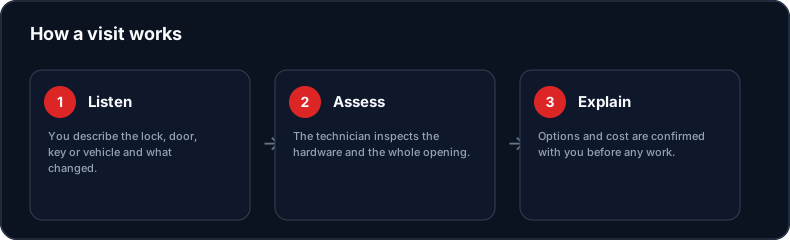
A firm price depends on seeing the work, so it is given after inspection rather than over the phone. What can be discussed on the call is the likely category of work and the factors that affect the cost: how many locks, what hardware, whether parts are needed, and the access involved. Any pricing is confirmed with you before work begins, and if an unexpected condition changes the picture once a lock is apart, that is explained before anything else is done.
Every access job requires proof that you are entitled to request it. For a home, identification matching the address, a lease, or mail. For a rental, the landlord or manager may need to confirm. For a business, an authorized contact. For a vehicle, registration or another ownership document. A locksmith who does not ask is a locksmith to be wary of.
The business is mobile and has no walk-in location, so it lists an area rather than an address. Neighbourhood boundaries overlap and mailing cities vary, so a street or nearest intersection is the reliable way to confirm coverage. Nearby communities are often covered even when they are not named on the service areas page.
Rekeying changes the internal combination of a lock you keep, so the old keys stop working; replacement swaps the hardware itself. Rekey when the lock is sound and you only need to control who has a working key, which is the usual case after a move or a lost key. Replace when the lock is worn, damaged, weak, or missing where you want one. The two are not interchangeable, and the guide works through how to tell which you need.
Whether a replacement car key can be made away from a dealer, and how, depends on the year, make and model. Older vehicles often take a simple cut key; newer ones need a transponder key or a proximity fob programmed to the vehicle, and a few are dealer-only. This is confirmed on the call. Proof of ownership is required. If you still have one working key, a spare is a smaller job than starting from none.
If a lock works with the door open and fails only when it is closed, the problem is alignment between the bolt and the strike, not the lock. Doors settle over years and move with Atlanta's humidity. The fix is adjusting the hinges, the strike or the strike opening, sometimes with a long screw into the framing. Replacing the lock first, before checking alignment, is a common and avoidable expense.
Most doors fail at the strike, not the lock, because the factory strike is held by short screws that only reach the trim. Three-inch screws into the framing, and a reinforced strike box, are the least expensive meaningful upgrade. Every exterior door should have a deadbolt that throws fully, and the deadbolt should actually be thrown. On glazed doors, weigh a single-cylinder deadbolt that can be reached through broken glass against a double-cylinder that needs a key to exit.
Can you get into any lock? Most residential and commercial locks can be opened without damage; a hardened high-security lock or a seized cylinder may need drilling and replacement, which is explained first. Will opening my door damage it? Non-destructive methods are used wherever the lock allows, so usually not. Do you work on safes? Basic servicing and lockouts on common safes, yes; specialised safe work is referred on. Can you match new locks to my current key? Often, if the keyways are compatible, which is checked first. How many keys will I get? That is agreed when the work is scheduled. Do you take card payment? Payment options are confirmed on the call.
Describe the situation on the contact page or by phone. Most questions can be answered before anyone is on site, and a firm recommendation follows once the hardware is inspected.
The reason a locksmith asks for proof that you can request the work is not bureaucracy; it is the main safeguard against helping the wrong person into a property or a vehicle. Acceptable proof is ordinary: a photo identification with an address that matches, a lease, a recent utility bill or piece of mail, a vehicle registration. For a rental, the landlord or property manager is often the party that has to authorize entry regardless of your own identification, so it is worth knowing your building's process before you need it. A locksmith who does not ask at all is not doing you a favour.
The client's phone line is listed as open 24 hours. The site does not state a specific arrival time because that depends on your location, the nature of the job and what is already booked; timing is given honestly on the call. Most standard work is completed on the first visit. Work that needs a special-order part, a colour-matched handleset, a new frame section or a manufacturer procedure is scheduled, and where an opening cannot be left unsecured in the meantime, a temporary measure is fitted.
Swapping a basic deadbolt on a standard, well-hung door is a reasonable do-it-yourself job if you are comfortable with tools. Bring in a locksmith when a door binds or has settled, when you want several locks keyed alike, when a lock has to be picked open, when a key is lost and a rekey is the safe response, for any vehicle key with a chip or fob, and for commercial hardware such as closers, panic devices and mortise or storefront locks. The parts that are quick for someone who does them daily, alignment and keying, are the parts that most often go wrong for someone doing them once.
If a lock has been getting harder to use, do not wait for it to fail. A stiff cylinder, a key that needs jiggling, a deadbolt that needs the door pulled tight, a handle that has started to wobble: each of these is a small, inexpensive fix now and a lockout, a snapped key or a failed part later. The same is true of a door that has never had its strike screws upgraded. These are quick to sort during any visit, and much less disruptive than dealing with them after they strand you.
A few signs separate a straightforward local locksmith from an operation to avoid. A fair locksmith gives you a general idea of pricing on the phone and a firm price to agree before starting work, rather than a low number that climbs sharply once someone arrives. They confirm your authorization to request the work. They default to opening a lock without damage and treat drilling as a stated last resort on a standard residential lock, not a first move. They recommend the work the hardware actually needs, which sometimes means talking you out of a replacement you asked for.
It is reasonable to ask, on the call: how will you open it, roughly what will it cost, and what happens to the lock afterward. The answers tell you most of what you need to know. A business with a real local service area, a published phone number and pages that explain how the work is done, rather than a wall of city names and superlatives, is generally a safer choice than a listing that exists only to capture a search.
If you are weighing a decision rather than dealing with a lockout, describe your specific situation on the contact page or by phone first. The likely answer is usually clear before anyone is on site, and it is confirmed once the hardware is inspected.
The Atlanta location, whether the request involves a home, business or car, and what the lock or key is doing. Mention a broken key, visible damage, a door that will not close, or a key that only works in certain positions. Car requests should include the year, make and model.
Fast Locksmith Service travels to customers as a service-area business and does not operate a public walk-in counter. Atlanta, GA 30309 identifies the base service area, not a walk-in address.
Yes. Ownership, residency or authorization must be confirmed before access work. Building managers, landlords and business representatives may need to confirm authority.
If the hardware works well and you only need old keys to stop working, rekeying may be enough. Replacement suits damaged hardware or a planned security change.
Often, when the lock cylinders and keyways are compatible. The existing hardware has to be inspected first.
Any pricing is explained on the call and confirmed before work begins.
For many vehicles, yes, depending on the year, make and model and the key type. Proof of ownership is required. It is confirmed by phone first.
Atlanta and nearby communities. See the service areas page or call with your exact location.
Call and tell us what is happening. The technician reviews the lock, door, key or vehicle and explains the options before any work begins.