
Mobile locksmith · Atlanta service-area business
Rekeying and replacing locks solve different problems. Here is how to tell which one you actually need after a move or a lost key.
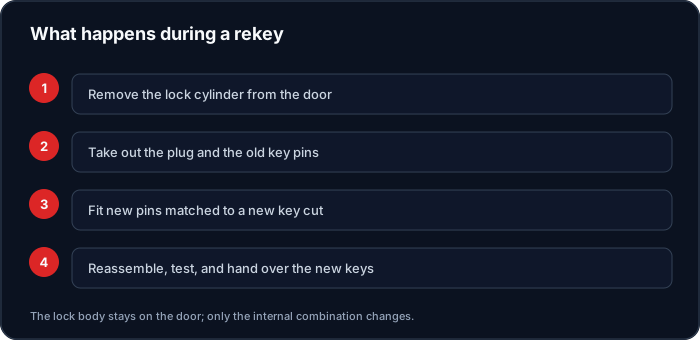
Rekeying changes the pins inside a lock cylinder so a different key operates it and the old key no longer does. The lock body, the bolt and the exterior trim all stay on the door. It is a small job on a lock that is otherwise in good condition.
Replacement swaps the physical hardware. You replace a lock when the cylinder is worn, the finish or body is damaged, the lock is a builder-grade unit you want to upgrade, or the door has no deadbolt and you want to add one.
You receive keys at closing, but you cannot know how many copies exist or who has them. If the existing deadbolts and entry locks are solid, rekeying every exterior lock to one new key is usually the practical choice. If a lock is already stiff or loose, that is the one to replace while the technician is there.
If the key cannot be connected to your address, cutting a replacement may be all you need. If it was on a ring with your address, or dropped somewhere near home, rekeying the locks that key fits is the safer step.
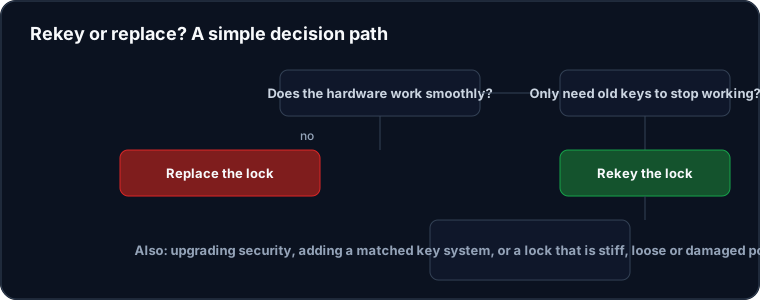
Ask two questions: does the hardware work smoothly, and do I only need the old keys to stop working? Two yeses point to rekeying. A no on the first points to replacement.
Rekeying and replacing a lock solve different problems, and the words get used loosely enough that people often ask for one when they need the other. Rekeying changes the internal combination of a lock you keep. Replacing swaps the physical hardware. Knowing which one you actually need saves money and, sometimes, saves you from paying for the wrong thing twice.
Inside a pin-tumbler cylinder, each keyway position has a stack of pins. The right key pushes every stack to the shear line, the gap that lets the plug turn. Rekeying takes the cylinder apart and fits a new set of key pins matched to a different key. The old key now stops some of the stacks short of the shear line, so it no longer works. The lock body, the bolt, the exterior finish and the trim all stay exactly where they are.
Because nothing is discarded, rekeying is usually the less expensive option, and a locksmith can often rekey every lock in a house during one visit. It is the right tool when the hardware is sound and the thing you actually want to change is who can open the door.
You replace a lock when the hardware itself is the problem or the goal. That covers a cylinder worn to the point that keys catch, a lock body or finish that is damaged, a builder-grade lock you want to upgrade to a higher grade, a door with no deadbolt where you want to add one, and a switch to a keypad or connected lock. Replacement is also the answer when a lock is so old that pins and springs are no longer available for it.
When you buy a home, you are handed keys, but you have no way to know how many copies exist or who holds them: past owners, their relatives, agents, cleaners, contractors and neighbours all accumulate keys. If the existing deadbolts and entry locks are in good condition, rekeying every exterior lock to one new key is the practical move. If one of the locks is already stiff, loose or clearly old, that is the one to replace while the locksmith is there, rather than rekeying something that is on its way out.
If you lose a key and it cannot be connected to your address, cutting a replacement may be all you need. If the key was on a ring with your address, dropped somewhere near home, or you think it was taken, then rekeying the locks that key fits is the safe choice. Cutting another copy of the same key does nothing in that situation, because the missing key still lines up the pins.
After a burglary, a break-up, or the loss of a full key ring, rekeying is almost always the right call. The question is not whether the lock still works; it is whether a key you no longer control can still open your door.
Ask two questions. First: does the hardware operate smoothly, with the bolt throwing fully and the key turning without effort? Second: is the only thing I need to change who can open the door? If both answers are yes, rekeying is very likely enough. A no to the first question points toward replacement, and a plan to upgrade security points there too. When you are not sure, describe the lock and the situation on the phone; the likely answer is usually clear before anyone is on site, and it is confirmed once the hardware is inspected.
Whichever route you take, it is worth handling every exterior door in the same visit and keying them alike so one key runs the house. Mixed keyways sometimes make that impossible without new cylinders, which is itself a reason to replace a few. A locksmith can tell you quickly which of your existing locks can be brought onto one key and which cannot.
Related services: rekeying, lock installation and residential locksmith.
Because rekeying reuses the lock body and only changes small internal parts, it is usually the lower-cost route, and the cost scales with the number of cylinders rather than with hardware. A locksmith can often rekey every exterior lock in a house in one visit. The variables are how many locks there are, whether they all take a compatible keyway so they can be keyed alike, and how many finished keys you want cut. A firm figure comes after the locks are seen, because a cylinder that turns out to be worn changes the recommendation.
There are situations where paying to rekey is a false economy. If a lock is already stiff, if the finish is corroded, if it is a lightweight builder-grade unit on an exterior door, or if the keyway is so old that pins and springs are hard to source, then rekeying spends money on hardware that will need replacing soon anyway. In a whole-house job it is common to rekey most doors and replace one or two, rather than treating every lock the same.
For a rental, the cleanest practice is to rekey the unit's exterior locks at every tenant change, record the new key in a schedule, and keep common-area and exterior building doors on a controlled keyway. That way each turnover is a small, predictable job rather than an open question about who still has a key. If the building's core keyway has been copied widely over the years, restoring control is a larger, staged project, but it starts with the same habit.
Rekey when the hardware is good and you need to control keys. Replace when the hardware is the problem or the goal. Do every exterior door in the same visit, key them alike where the cylinders allow, and keep a short record of how many keys exist. If you are unsure which applies, describe the locks on the phone; the likely answer is usually clear before anyone is on site.
Whenever a locksmith or a handyman has a lock apart for any reason, ask them to confirm two things: that the deadbolt throws its full length into the strike, and that the strike is held by screws long enough to reach the framing behind the jamb. Both take a minute to check, both are common failings even on otherwise good installations, and catching them during a visit you are already paying for costs nothing extra.
You buy a 1930s bungalow. It has three exterior doors: a front deadbolt that turns smoothly, a side-door lock that is stiff and rusty, and a basement door with only an old rim lock. The sensible plan is to rekey the front deadbolt to a new key, replace the stiff side-door lock with a new deadbolt keyed to the same key, and add a modern deadbolt to the basement door, also on that key. One key now runs the house, nothing sound was thrown away, and the two weak points were dealt with. That mix, rekey the good, replace the bad, is far more common than treating every door the same way.
A few signs separate a straightforward local locksmith from an operation to avoid. A fair locksmith gives you a general idea of pricing on the phone and a firm price to agree before starting work, rather than a low number that climbs sharply once someone arrives. They confirm your authorization to request the work. They default to opening a lock without damage and treat drilling as a stated last resort on a standard residential lock, not a first move. They recommend the work the hardware actually needs, which sometimes means talking you out of a replacement you asked for.
It is reasonable to ask, on the call: how will you open it, roughly what will it cost, and what happens to the lock afterward. The answers tell you most of what you need to know. A business with a real local service area, a published phone number and pages that explain how the work is done, rather than a wall of city names and superlatives, is generally a safer choice than a listing that exists only to capture a search.
If you are weighing a decision rather than dealing with a lockout, describe your specific situation on the contact page or by phone first. The likely answer is usually clear before anyone is on site, and it is confirmed once the hardware is inspected.
Call and tell us what is happening. The technician reviews the lock, door, key or vehicle and explains the options before any work begins.