
Mobile locksmith · Atlanta service-area business
Help outside normal hours for lockouts, broken keys, and doors or locks that will not secure a home or business.
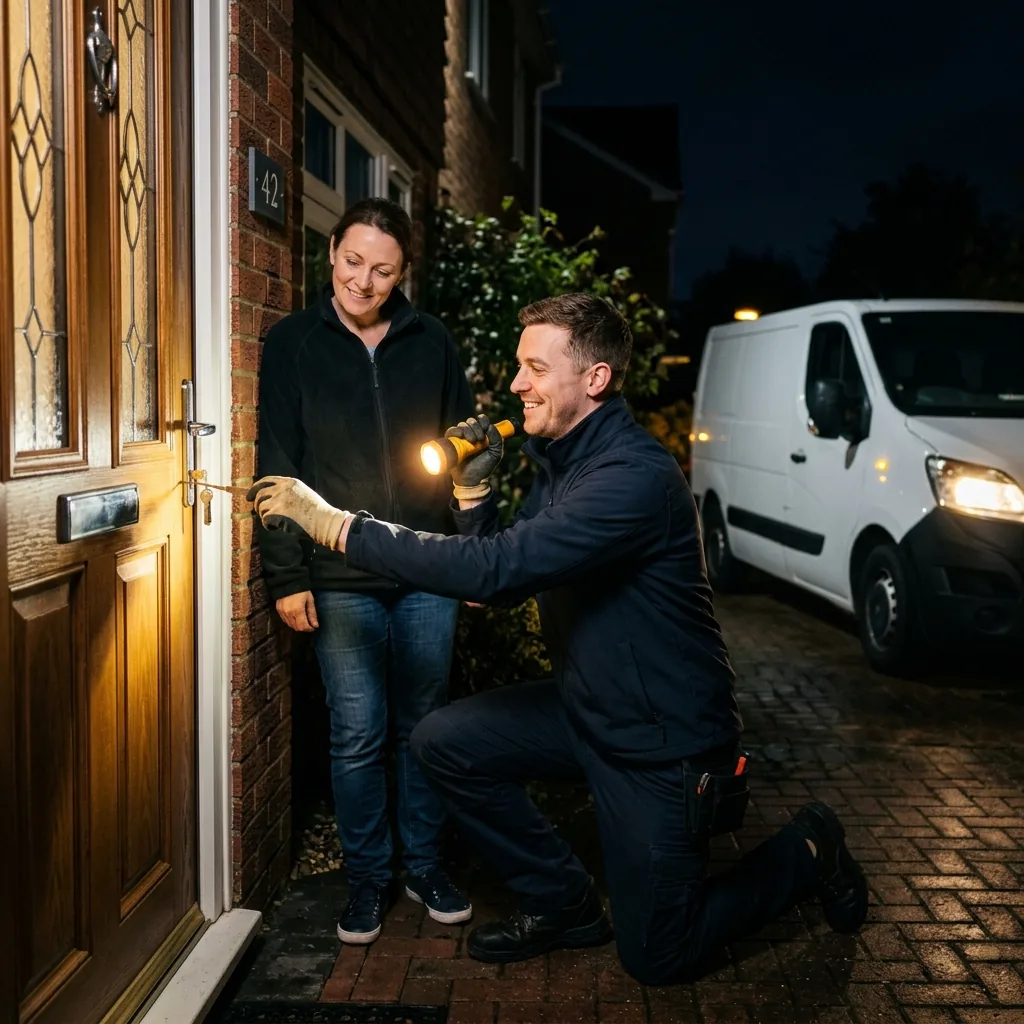
A home or business that cannot be locked, a key broken off in a lock, a lockout that leaves someone without access, or a door that will not close. Describe what you can see and hear when you call.
Your Atlanta location or nearest cross street, whether it is a home, business or vehicle, and proof that you are authorized to request access.
The situation is reviewed, coverage is confirmed and the likely service is identified. A firm recommendation depends on inspecting the lock, door or vehicle on site.
Some lock and key problems cannot wait for the next working day: a home or business that will not lock, a key snapped off in a cylinder, a lockout that has left someone without access to where they live or work, or a door that will not close. The client's phone line is listed as open 24 hours, and calling is the most direct way to explain the situation and find out what can be done and when.
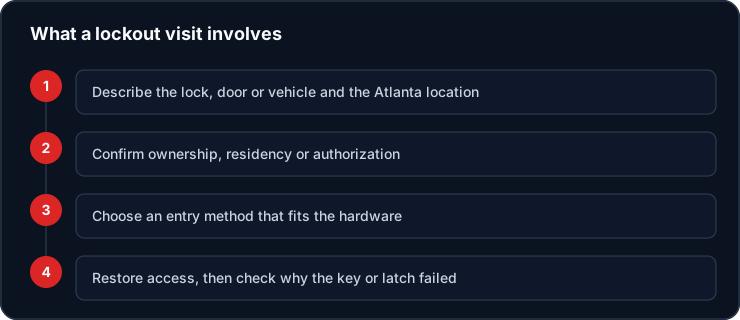
You describe what has happened, where you are in Atlanta, and whether it is a home, a business or a vehicle. Coverage is confirmed, the likely service is identified, and any pricing is explained before work begins. A firm recommendation still depends on inspecting the lock, the door or the vehicle in person, because the same symptom can have more than one cause and after-hours calls are no exception.
The requirement to confirm ownership, residency or authorization does not change outside business hours. For a home, that is usually identification matching the address; for a rental, a lease or a manager's confirmation; for a business, an authorized contact; for a vehicle, ownership documentation. This protects you and everyone else involved, and a locksmith who is willing to skip it late at night is one to avoid.
If a door or lock has failed and the opening cannot be secured, a temporary measure can often hold it until a full repair or replacement is scheduled at a normal time. That might mean fitting a temporary cylinder, adjusting hardware enough to lock, or securing the door by another means. The permanent fix is planned separately once the hardware has been properly assessed in daylight with the right parts.
If a key is unaccounted for after a break-in or a loss, rekeying the affected locks is what makes the missing key useless. Cutting a new copy of the same key does not.
If a door or window has been forced, photograph the damage before anything is touched and contact the police so there is a report for any insurance claim. Once that is done, the priority is making the property secure: a forced door often needs the frame and strike repaired as well as the lock, and any lock that a lost or copied key might fit should be rekeyed. Some of this can be temporary overnight and completed properly the next day.
If a person or a pet is shut inside a hot vehicle, or anyone is in danger, call 911 before a locksmith. A locksmith is the right call for an ordinary lockout or a failed lock, not for a situation that has become dangerous.
Related pages: lockout service, lock repair and rekeying.
Getting you back in, extracting a broken key, and making a door lockable again are the kinds of thing that suit an after-hours visit. A full replacement that needs a special-order part, a new door or frame section, or a colour-matched handleset is usually better completed during the day when parts can be sourced. In those cases a temporary measure holds the opening overnight and the proper work is scheduled.
It can be tempting to hope that a late call means fewer questions. It does not, and it should not. Authorization, a clear look at the hardware, and a price agreed before work starts protect you from a bad outcome at exactly the time you are least able to shop around. A locksmith who skips those steps after dark is the one to be most careful with.
Most after-hours calls trace back to something preventable: a single key with no spare, a self-latching door, a lock that had been getting harder to turn for weeks, or a key that had visibly started to bend. A spare key held off-site, a closer adjustment on a storm door, and dealing with a stiff lock while it is still just stiff will head off the large majority of them.
Have your address or nearest intersection ready, know whether it is a home, a business or a vehicle and which door, be able to say what has failed, and have identification or documentation that shows you are authorized to request the work. If it is a rental, know whether your landlord or manager has to approve entry, because in many cases they do and that call has to happen first. If a working spare key exists anywhere, mention it, because retrieving a spare is faster and less costly than any other route.
After-hours work is for the problems that genuinely cannot wait: a home or business that will not lock, a key broken in a cylinder, a lockout with no other way in, a door that will not close. The client's phone line is listed as open 24 hours, authorization and a price agreed in advance still apply, and anything that needs a special-order part is held with a temporary measure and finished properly during the day.
Fast Locksmith Service travels to the customer and does not run a public walk-in shop, so the first contact is a phone call or the contact form rather than a counter visit. On the call you describe the lock, the door, the key or the vehicle and what changed; coverage is confirmed against your street or nearest intersection; and the likely category of work and the factors affecting its cost are discussed. A firm recommendation and a firm price still depend on the technician seeing the hardware, because the same symptom often has more than one cause.
Every access job requires proof that you own, occupy or are authorized to control the property or vehicle. For a home that is usually identification matching the address; for a rental, a lease or a manager's confirmation; for a business, an authorized contact; for a vehicle, ownership documentation. This is routine, it protects everyone, and a locksmith who is willing to skip it is one to be cautious about.
Wherever the lock allows, it is opened or serviced without damage: picking, bypass tools, and decoding leave the hardware usable afterwards. Drilling is a last resort for a seized or hardened lock, or one that is already broken, and the technician explains that it is next and that the lock will be replaced before doing it.
For planned work, a few photographs of the whole door and both faces of the hardware help the technician arrive prepared, and clearing the space around each door speeds the job. Afterwards, the technician checks that bolts throw fully with the door open and closed, that keys turn without effort, and that strike screws are tight in solid material, and explains anything that may need a further small adjustment as an older door continues to move with the seasons. The client's phone line is listed as open 24 hours, and any pricing is confirmed before work begins.
The client's phone line is listed as open 24 hours. Calling is the most direct way to reach us and to confirm what can be done and when.
Any pricing is explained on the call and confirmed before work begins.
Often, yes. A temporary measure can hold the opening until a full repair or replacement is scheduled.
A firm price depends on inspecting the work. The factors that affect it are how many locks or doors are involved, the type and condition of the hardware, whether any parts are needed, and the access at the site. Any pricing is explained on the call in general terms and confirmed before work begins; if an unexpected condition changes the picture once a lock is apart, that is explained before anything else is done.
In most cases, yes, when the hardware is standard and no special-order part is required. Where a part has to be sourced, the technician explains that and arranges a return visit.
Then that is what you are told. If you ask for a rekey but the lock is worn out, or for a replacement when a small adjustment would fix it, the technician explains the difference and the reasoning before any work.
Call and tell us what is happening. The technician reviews the lock, door, key or vehicle and explains the options before any work begins.