
Mobile locksmith · Atlanta service-area business
Call for direct assistance, or send the details of your Atlanta lock or key request.
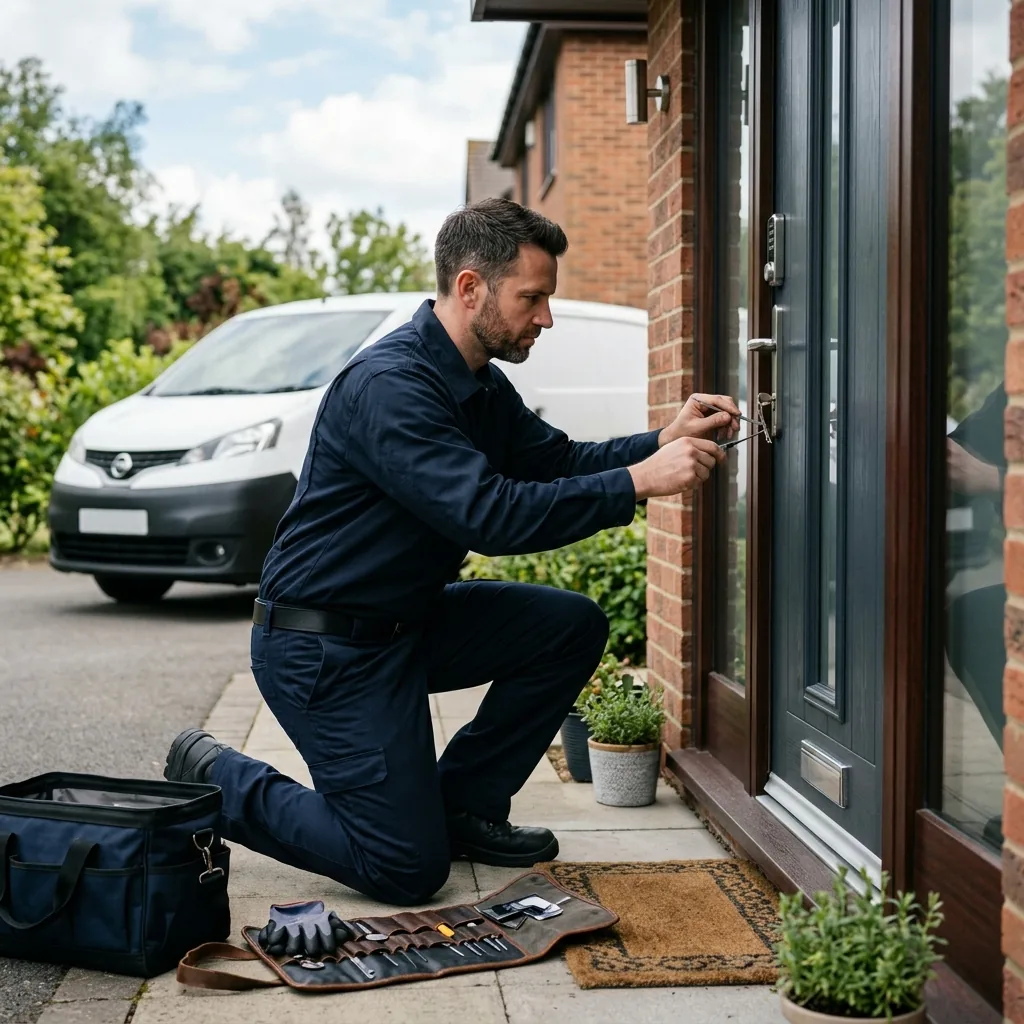
Fast Locksmith Service is a mobile service-area business. A public walk-in address is not listed. Calling is the most direct way to confirm a location and what can be done.
Tell us the Atlanta location, whether the request involves a home, business or car, and what the lock or key is doing. Mention a broken key, visible damage, a door that will not close, or a key that only works in certain positions. Car requests should include the year, make and model.
Access work requires proof that the customer owns, occupies or is authorized to control the property or car. Have identification and supporting documents available. Building managers, landlords and business representatives may need to confirm authority.
For houses, apartments and condos, review residential locksmith service. Businesses and property managers can use commercial locksmith service. For car lockouts, replacement keys or ignition concerns, visit car locksmith.
Whether you call or send the form, a few details make the response accurate. The Atlanta location, ideally a street or nearest intersection. Whether the request is a home, a business or a vehicle. What the lock or key is doing, in plain terms: the key will not turn, the bolt will not throw, the handle is loose, the door will not latch, the key snapped. Whether the problem came on suddenly or gradually. For a vehicle, the year, make and model.
Access work requires proof that you own, occupy or are authorized to control the property or vehicle. Have identification and supporting documents ready. Building managers, landlords and business representatives may need to confirm authority for work on a shared entrance or a tenant space. This is routine and it protects everyone.
For a planned repair, rekey or installation, clear photographs of the whole door and of both sides of the hardware help identify the lock type and what will be needed. Do not include identification documents, payment information or access codes in an ordinary message.
The request is reviewed, coverage is confirmed, and the likely service is identified. A firm recommendation and price depend on inspecting the lock, the door, the key or the vehicle in person. If the property cannot be secured, calling is more direct than the form. The FAQ covers the questions that come up on most calls, and the services page lists the specific work.
Say whether the key turns, whether the latch or bolt retracts, and whether the lock behaves differently while the door is open. Mention loose handles, visible damage and any recent work on the door or the weatherstripping. For a managed property, identify who can approve access and hardware changes. The more precisely the symptom is described, the more accurately the likely work and cost can be discussed before anyone is on site.
Have the year, make and model ready. Say whether all keys are lost or a working spare exists, and whether a locked-in key is visible, in the trunk, or unknown. Describe any dashboard messages exactly, and mention aftermarket alarm or remote-start equipment. For a car in a parking deck, give the deck, level and any security procedure.
The client's phone line is listed as open 24 hours. For a lockout, a broken key, or a door that will not secure, calling is the most direct route. The after-hours page explains what can usually be finished at the time and what is better scheduled for the day.
Call when a property or vehicle cannot be secured, when you are locked out, or when you want to talk through options before deciding. Use the form for planned work, when you can include photographs, or when it is simply more convenient; it opens your own email application and does not send anything automatically, so nothing is transmitted until you send it. Either way, the more precisely the problem is described, the more accurate the response.
Residential covers lockouts, rekeying, repair and installation for houses, condominiums and apartments. Commercial covers rekeying, hardware repair and replacement, and key organisation for offices, storefronts and managed properties. Automotive covers lockouts, replacement keys and fobs, broken-key extraction and ignition assessment. After-hours covers lockouts, broken keys and doors that will not secure outside normal hours. Each has a page under services with the detail.
Contact details you provide are used to respond to your request, schedule work and follow up about the job. They are not sold or rented. Do not include identification documents, payment information or access codes in an ordinary message; those are handled in person.
A short message that covers the essentials is more useful than a long one that does not. A good example: "Rented townhome near Krog Street, Inman Park. Front deadbolt has to be lifted to lock; back door lock is loose in the door. Would like both looked at and, if it makes sense, all exterior doors on one key. I can be there weekday afternoons and have a lease and photo ID." That tells the technician the location, the symptoms, the likely work, the access and the authorization in four sentences.
The request is read, coverage is confirmed against your location, and the likely service and the factors affecting its cost are identified. A firm recommendation and price still depend on inspecting the hardware in person, because the same description can turn out to be more than one job. If the situation is that a property or vehicle cannot be secured, a phone call is more direct than waiting on a message.
For planned work, such as a rekey after a move, a set of new deadbolts or a lock that has been getting stiff, the form is often the easier route because you can include photographs of the door and both faces of the hardware and describe your availability. That lets the technician arrive with the right parts and enough time. Clearing the area around each door before the appointment, and having any key you want new locks matched to, keeps the visit short.
The contact form opens your own email application and does not transmit anything on its own, so if you close the message without sending it, nothing is received. For anything where a property or vehicle is not secure, or where you are locked out, calling is the right channel rather than a message, because it is direct and the situation can be assessed in the conversation. A message suits planned work, questions, and anything where you want to attach photographs of the door and hardware.
A first message never needs your identification documents, a photograph of your driver's licence, a payment card number, or any door or alarm code. Authorization is checked in person at the visit, and payment is handled then. If a message or a form ever asks you to send those things up front, treat that as a warning sign. A plain description of the problem, the location and your availability is all that is useful at this stage.
The services page links to each specific service with a full explanation: residential, commercial and automotive locksmith work, plus rekeying, repair, installation, key replacement and after-hours help. If you are not sure which applies, describe the problem and it will be identified for you; getting the category wrong on the phone is common and easily sorted.
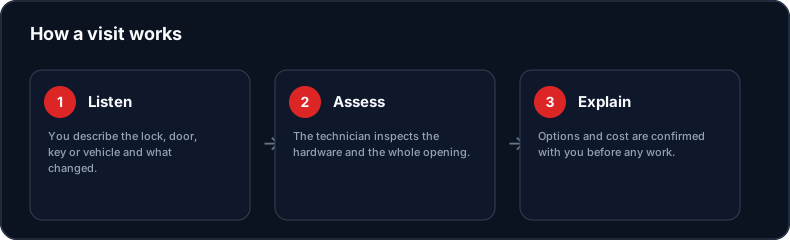
Fast Locksmith Service travels to the customer and does not run a public walk-in shop, so the first contact is a phone call or the contact form rather than a counter visit. On the call you describe the lock, the door, the key or the vehicle and what changed; coverage is confirmed against your street or nearest intersection; and the likely category of work and the factors affecting its cost are discussed. A firm recommendation and a firm price still depend on the technician seeing the hardware, because the same symptom often has more than one cause.
Every access job requires proof that you own, occupy or are authorized to control the property or vehicle. For a home that is usually identification matching the address; for a rental, a lease or a manager's confirmation; for a business, an authorized contact; for a vehicle, ownership documentation. This is routine, it protects everyone, and a locksmith who is willing to skip it is one to be cautious about.
Wherever the lock allows, it is opened or serviced without damage: picking, bypass tools, and decoding leave the hardware usable afterwards. Drilling is a last resort for a seized or hardened lock, or one that is already broken, and the technician explains that it is next and that the lock will be replaced before doing it.
For planned work, a few photographs of the whole door and both faces of the hardware help the technician arrive prepared, and clearing the space around each door speeds the job. Afterwards, the technician checks that bolts throw fully with the door open and closed, that keys turn without effort, and that strike screws are tight in solid material, and explains anything that may need a further small adjustment as an older door continues to move with the seasons. The client's phone line is listed as open 24 hours, and any pricing is confirmed before work begins.
Call and tell us what is happening. The technician reviews the lock, door, key or vehicle and explains the options before any work begins.