
Mobile locksmith · Atlanta service-area business
Regain access to a home, office or car with entry methods chosen for the specific lock. Authorization is confirmed before work begins.
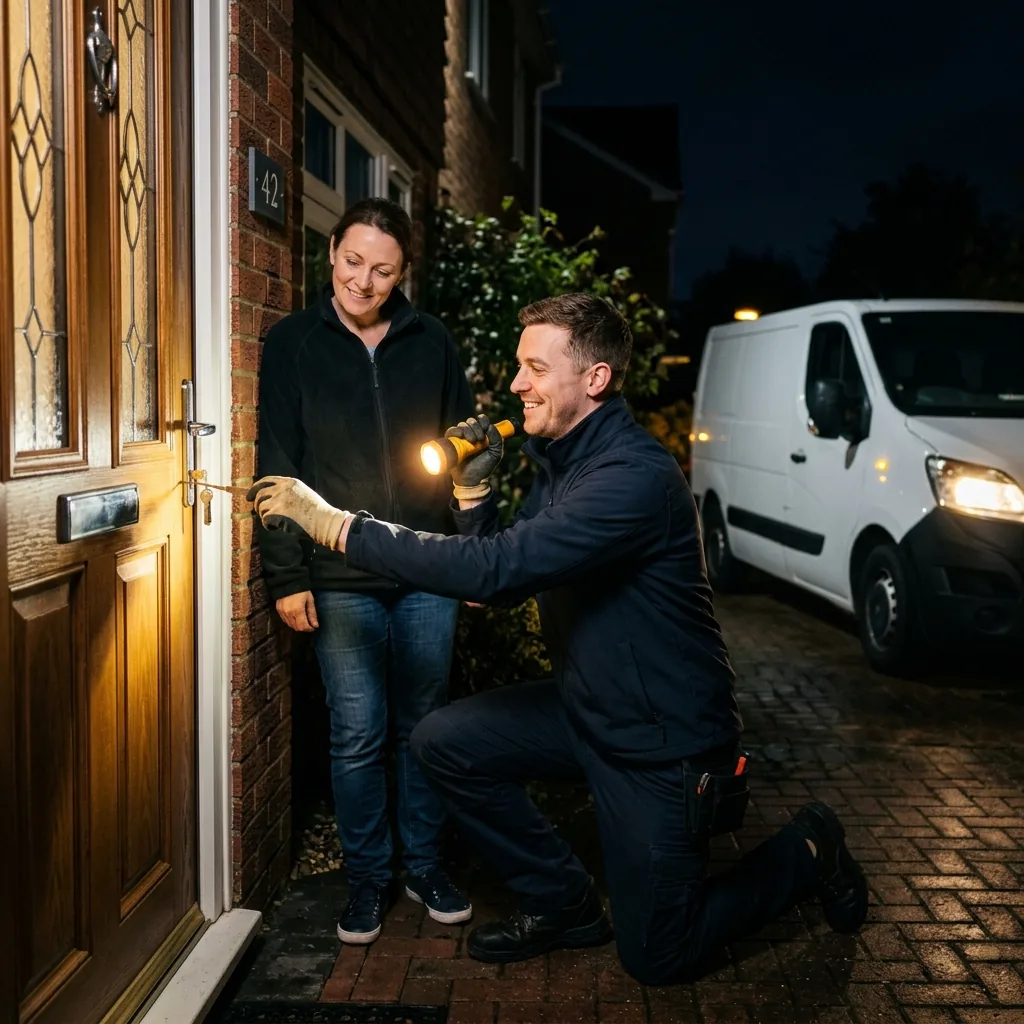
Explain whether the issue is at a building entrance, a unit door or an interior room. The lock is assessed, access is restored, and the reason the key or latch failed can then be checked.
Identify the person who can authorize entry. Commercial hardware varies, so the door and lock are reviewed before an opening method is chosen.
Give the year, make and model and say whether a working spare exists. Proof of ownership is required.
Being locked out is stressful, but it is a routine job with a routine solution. The goal is to get you back in without damaging the hardware, and then to understand why it happened so it does not repeat. Fast Locksmith Service handles lockouts for homes, offices and vehicles across the Atlanta area, and the client's phone line is listed as open 24 hours.
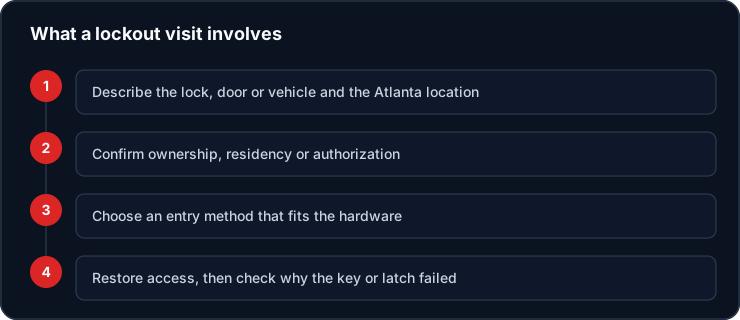
The technician confirms that you own the property or vehicle, live or work there, or are otherwise authorized to be let in. For a home that can be identification matching the address; for a rental, a lease or a manager's confirmation; for a vehicle, registration or another ownership document. This step is not negotiable and it protects you as much as anyone. A locksmith who skips it is a locksmith to be wary of.
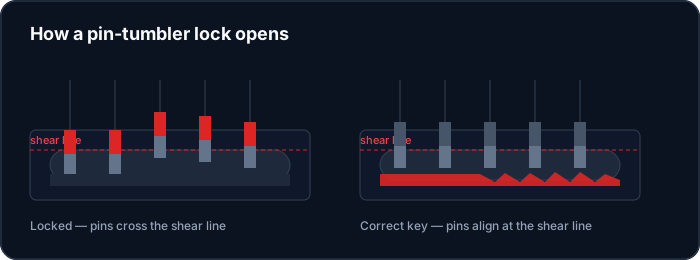
Most residential and commercial pin-tumbler locks can be opened by manipulating the pins to the shear line with a pick and a tension tool, or with a pick gun that bounces the pins into place. Some locks can be opened with a bypass tool that never touches the keyway, such as a tool that retracts a spring latch, or one that reaches an interior thumbturn through a gap in the door. A working key can sometimes be produced on site by decoding the lock. Each of these leaves the lock fully usable afterwards.
Drilling is a last resort, used when a cylinder has seized, when a hardened high-security lock will not yield under reasonable effort, or when the lock is already broken. A technician tells you before drilling and expects to replace the lock afterwards. There is more detail on the guide, how a locksmith opens a locked door.
Say whether the issue is at a building entrance, the unit door or an interior room, and whether the lock is a knob, a deadbolt, a lever, a keypad or a connected lock. An interior door with a privacy latch is a very different job from a deadbolt on an exterior steel door.
Identify who can authorize entry before the visit. Commercial hardware varies widely, and a mortise lock, a storefront deadlatch and a panic device each need a different approach. If the lockout affects a shared entrance in a multi-tenant building, the property manager may need to be involved.
Give the year, make and model and say whether a working spare exists and where the locked-in key is. That determines the tools brought to the job.
If a spring latch closed on its own, a door closer or a worn latch spring is usually the reason, and it will keep happening until that is addressed. If a key failed, comparing it with a spare shows whether the key or the lock is worn. If a key is unaccounted for, rekeying the affected locks is the way to be certain the missing key no longer opens the door.
If your key broke off in the lock, keep the head of the key. It helps identify the blank and confirms the keyway when a replacement is cut.
You can also reach us through the contact page. Related services include rekeying, lock repair and after-hours locksmith help.
The lock, not the situation, sets the pace. A basic residential knob or a builder-grade deadbolt opens quickly by picking or bypass. A high-security cylinder with security pins and anti-drill protection takes longer by design, because that resistance is exactly what you paid for. A commercial mortise lock, a storefront deadlatch and a vehicle with electronic latches each need their own method and tools. Describing the lock accurately on the call means the technician arrives ready for it.
A bedroom or bathroom door with a privacy latch, where a child has locked it from inside or the button has jammed, is a common and quick call. These usually open with a small tool through the face hole, or by releasing the latch mechanism. It is worth knowing that most interior privacy sets are designed to be overridden this way in exactly this situation.
Fitting a deadbolt with a captured or deadlocking latch removes the trick of slipping a plain spring latch. Keeping the deadbolt thrown whenever you are home closes the same gap. A spare key with a neighbour, a lockbox with a code you actually remember, or a keypad lock on the everyday door all give you a way back in that does not involve a call. And a self-closing storm door that keeps latching the main door behind you can have its closer adjusted so it stops doing that.
Have your address or nearest cross street, know whether it is a home, a business or a vehicle and which door, say whether a spare key exists and where, and for a vehicle have the year, make and model. Be ready to show identification or documentation that you are authorized to request entry. For a managed building or a parking deck, know how the technician reaches the door and who, if anyone, has to approve the visit.
Fast Locksmith Service travels to the customer and does not run a public walk-in shop, so the first contact is a phone call or the contact form rather than a counter visit. On the call you describe the lock, the door, the key or the vehicle and what changed; coverage is confirmed against your street or nearest intersection; and the likely category of work and the factors affecting its cost are discussed. A firm recommendation and a firm price still depend on the technician seeing the hardware, because the same symptom often has more than one cause.
Every access job requires proof that you own, occupy or are authorized to control the property or vehicle. For a home that is usually identification matching the address; for a rental, a lease or a manager's confirmation; for a business, an authorized contact; for a vehicle, ownership documentation. This is routine, it protects everyone, and a locksmith who is willing to skip it is one to be cautious about.
Wherever the lock allows, it is opened or serviced without damage: picking, bypass tools, and decoding leave the hardware usable afterwards. Drilling is a last resort for a seized or hardened lock, or one that is already broken, and the technician explains that it is next and that the lock will be replaced before doing it.
For planned work, a few photographs of the whole door and both faces of the hardware help the technician arrive prepared, and clearing the space around each door speeds the job. Afterwards, the technician checks that bolts throw fully with the door open and closed, that keys turn without effort, and that strike screws are tight in solid material, and explains anything that may need a further small adjustment as an older door continues to move with the seasons. The client's phone line is listed as open 24 hours, and any pricing is confirmed before work begins.
Yes. Ownership, residency or authorization is confirmed before access work.
The method is chosen to fit the hardware. If a lock is already failing, that is explained before work continues.
The broken piece is extracted and the lock is checked to see whether it still operates correctly.
A firm price depends on inspecting the work. The factors that affect it are how many locks or doors are involved, the type and condition of the hardware, whether any parts are needed, and the access at the site. Any pricing is explained on the call in general terms and confirmed before work begins; if an unexpected condition changes the picture once a lock is apart, that is explained before anything else is done.
In most cases, yes, when the hardware is standard and no special-order part is required. Where a part has to be sourced, the technician explains that and arranges a return visit.
Then that is what you are told. If you ask for a rekey but the lock is worn out, or for a replacement when a small adjustment would fix it, the technician explains the difference and the reasoning before any work.
Call and tell us what is happening. The technician reviews the lock, door, key or vehicle and explains the options before any work begins.