
Mobile locksmith · Atlanta service-area business
Rekeying changes the internal key combination of a compatible lock so older keys stop working, without replacing the whole lock.
After moving into a home, after tenant turnover, when a key is lost, or when you want several compatible locks to share one key.
A worn or damaged cylinder, a misaligned deadbolt or a broken latch. Those are handled through repair or replacement, which is explained if found.
When cylinders and keyways match, locks can often be rekeyed to a single key. The existing hardware is inspected first to confirm.
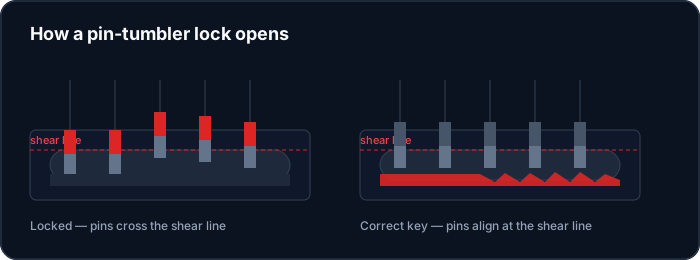
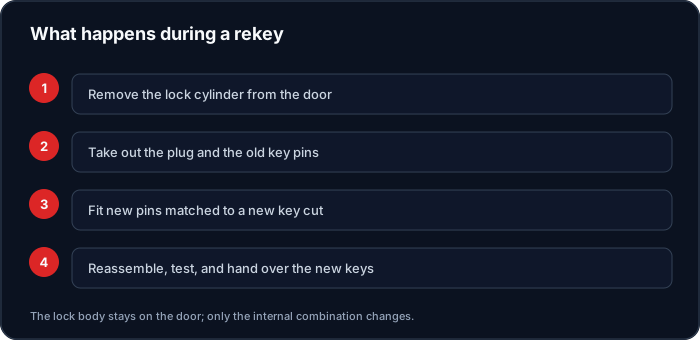
Every pin-tumbler lock contains a stack of small pins for each position in the keyway. The cuts on the correct key push those stacks to a precise line, called the shear line, which lets the plug rotate. Rekeying replaces the key pins with a different set, matched to a different key. The lock body, the bolt and the exterior trim all stay on the door; only the internal combination changes, and the old key no longer lines the pins up.
Rekeying suits the situations where the hardware is fine but you need control of who can open the door: moving into a home, tenant turnover, a lost or stolen key, a departed housemate or employee, or wanting several compatible locks to share one key. It is usually less expensive than replacing locks because nothing is discarded, and a whole house can often be done in one visit.
You cannot know how many copies of the previous keys exist. Rekeying every exterior lock to one new key is a small job that resets that completely. If a lock is stiff or loose while the technician is there, that is the one to look at for repair or replacement rather than rekeying a lock that is already failing.
If the key cannot be connected to your address, cutting a replacement may be all you need. If it was on a ring with your address, dropped near home, or taken, rekeying the locks that key fits is the step that restores control.
Rekeying does not repair a worn cylinder, straighten a misaligned deadbolt, fix a loose handle or upgrade a weak lock. If the inspection turns up any of those, they are handled through repair or replacement, and explained before any work. A lock that is already failing is not a good candidate for rekeying on its own.
If your doors currently take three or four different keys, matching cylinders can usually be rekeyed so one key operates all of them. The locks have to share a compatible keyway, which is checked first; many common residential brands are compatible with one another, and some are not. Keying alike removes the daily nuisance of the wrong key and makes it realistic to keep track of how many copies exist.
Rekeying is the honest answer after a burglary or a lost key ring. Cutting a new copy of the same key does nothing, because the outstanding key still works. Changing the combination is what makes it useless.
Rekeying between tenants is a routine, contained job: the unit's exterior locks are rekeyed to a fresh key, the previous tenant's keys stop working, and the change is written into the key schedule. Doing this consistently, and keeping exterior and common-area doors on a controlled keyway, is what keeps a rental property's keys under control over the years. A simple master arrangement lets maintenance carry one key while each unit keeps its own.
The full comparison of rekeying and replacement is on the guide, rekey or replace your locks.
Part of a rekey is deciding how many copies to have cut and keeping a simple record of who has them. Two or three keys per household is typical; a rental might have one for the tenant and one held by management. The value of the record is not bureaucratic: it is what lets you answer, later, whether a missing key means you need another rekey. A rekey with no record of keys is only half done.
Keying locks alike depends on the cylinders sharing a keyway and accepting the same pinning. Several common residential brands are cross-compatible, and some are not; a few use proprietary keyways that cannot be matched to anything else without changing cylinders. A locksmith can tell quickly from the locks on your doors which can be brought onto one key and which would need a new cylinder to join the set. That is worth knowing before you decide between rekeying and replacing.
Most connected and keypad deadbolts still have a mechanical key cylinder as a backup, and that cylinder can usually be rekeyed like any other, so a smart lock can be brought onto the same key as your traditional locks. The digital side, codes and app access, is managed separately in the lock's own settings, and revoking a code there is the digital equivalent of a rekey.
Know how many locks and exterior doors are involved, whether you want them all keyed alike or kept separate, and the lock brands if you can identify them or a clear photo of the cylinders. Mention any lock that is stiff, loose or damaged so it can be looked at for repair or replacement rather than rekeyed. Decide roughly how many finished keys you want, and be ready to show proof of ownership, residency or authorization.
Fast Locksmith Service travels to the customer and does not run a public walk-in shop, so the first contact is a phone call or the contact form rather than a counter visit. On the call you describe the lock, the door, the key or the vehicle and what changed; coverage is confirmed against your street or nearest intersection; and the likely category of work and the factors affecting its cost are discussed. A firm recommendation and a firm price still depend on the technician seeing the hardware, because the same symptom often has more than one cause.
Every access job requires proof that you own, occupy or are authorized to control the property or vehicle. For a home that is usually identification matching the address; for a rental, a lease or a manager's confirmation; for a business, an authorized contact; for a vehicle, ownership documentation. This is routine, it protects everyone, and a locksmith who is willing to skip it is one to be cautious about.
Wherever the lock allows, it is opened or serviced without damage: picking, bypass tools, and decoding leave the hardware usable afterwards. Drilling is a last resort for a seized or hardened lock, or one that is already broken, and the technician explains that it is next and that the lock will be replaced before doing it.
For planned work, a few photographs of the whole door and both faces of the hardware help the technician arrive prepared, and clearing the space around each door speeds the job. Afterwards, the technician checks that bolts throw fully with the door open and closed, that keys turn without effort, and that strike screws are tight in solid material, and explains anything that may need a further small adjustment as an older door continues to move with the seasons. The client's phone line is listed as open 24 hours, and any pricing is confirmed before work begins.
Usually, because the existing hardware stays in place. Replacement is only recommended when a lock is damaged or unsuitable.
The number of keys is confirmed when the work is scheduled.
Many smart locks have a keyed cylinder that can be rekeyed. The specific model is checked first.
A firm price depends on inspecting the work. The factors that affect it are how many locks or doors are involved, the type and condition of the hardware, whether any parts are needed, and the access at the site. Any pricing is explained on the call in general terms and confirmed before work begins; if an unexpected condition changes the picture once a lock is apart, that is explained before anything else is done.
In most cases, yes, when the hardware is standard and no special-order part is required. Where a part has to be sourced, the technician explains that and arranges a return visit.
Then that is what you are told. If you ask for a rekey but the lock is worn out, or for a replacement when a small adjustment would fix it, the technician explains the difference and the reasoning before any work.
Call and tell us what is happening. The technician reviews the lock, door, key or vehicle and explains the options before any work begins.