
Mobile locksmith · Atlanta service-area business
Practical lock and key support for storefronts, offices, property managers and local facilities across the Atlanta area.
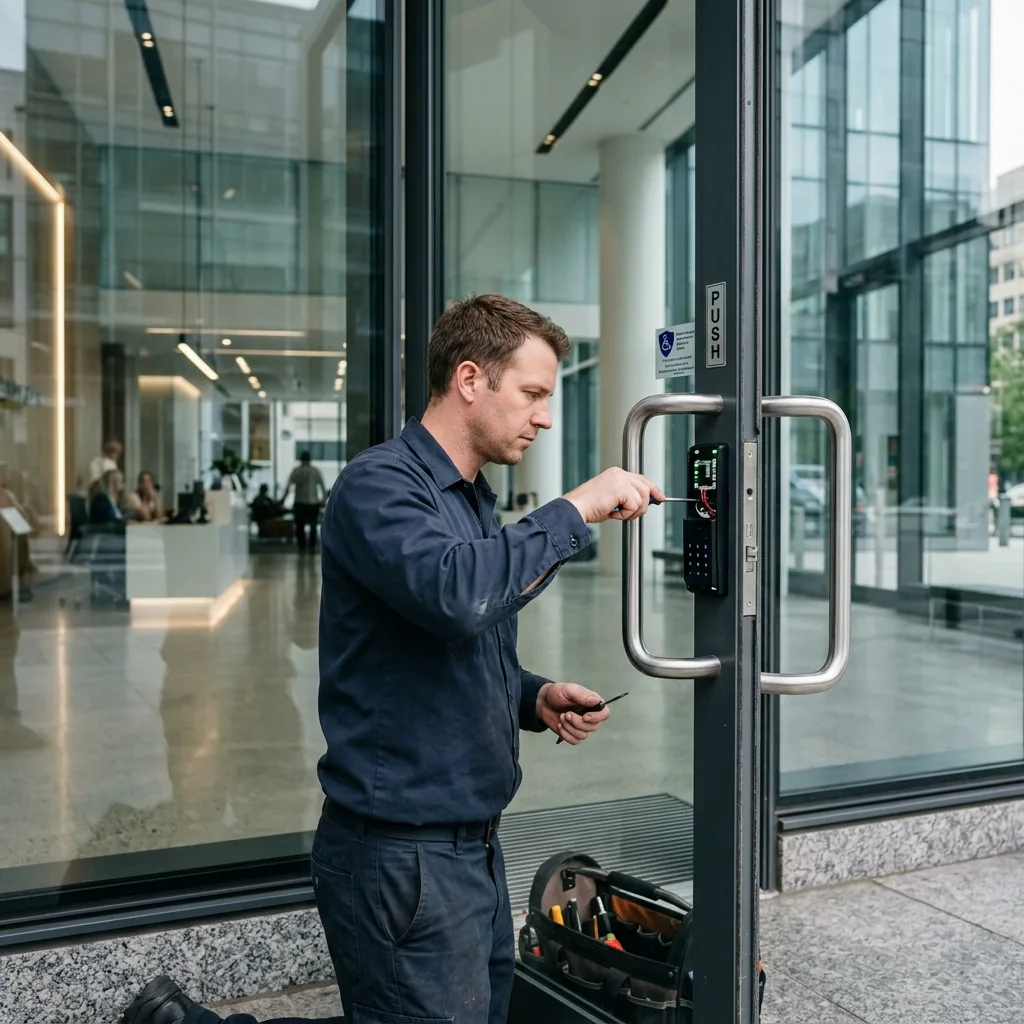
Businesses change staff, and keys are not always returned. Rekeying compatible cylinders makes older keys stop working, and a simple key plan keeps entrances, offices and storage areas separated.
Commercial doors carry heavy traffic and often use closers, panic hardware and specialized cylinders. The whole opening is checked so a repair holds up.
Mortise locks, lever sets, deadbolts and cylindrical locks are all serviced. Where hardware is failing, replacement options are explained before any work begins.
A business door is used far more often than a home door and usually carries hardware built for that: door closers, panic and exit devices, mortise locks, heavy-duty lever sets and, in many cases, cylinders that belong to a keyway shared across the whole property. Because the opening is part of how the business runs, a commercial visit looks at the complete door, confirms who is authorized to approve changes, and plans the work so it does not leave an entrance unsecured.
Fast Locksmith Service supports storefronts, offices, restaurants, salons, medical and professional suites, warehouses and managed multi-tenant properties across the Atlanta area. The common requests are rekeying after staff changes, repairing or replacing hardware that has worn out, organising keys so the right people reach the right doors, and servicing mailbox, cabinet and furniture locks.
Keys are rarely all returned when someone leaves. Rekeying the affected cylinders makes the outstanding keys stop working without the cost or downtime of replacing lock bodies. For a small site this can often be done in a single visit; for a larger property it is planned door by door so operations continue. A written record of which key opens which door, updated each time a change is made, is the difference between a key system that stays under control and one that slowly stops meaning anything.
It is worth rekeying not only when someone leaves on bad terms, but on any planned schedule that suits the business, and whenever a key cannot be accounted for. A key with a tag that identifies the address is a particular risk and is worth treating as lost.
In a master key system, every door keeps its own individual key while one master key operates a defined group of doors. A manager might carry a key that opens the front entrance, the office and the storeroom, while each of those doors also has its own key held by the people who only need that room. Larger systems add levels between the two, such as a floor master or a department master.
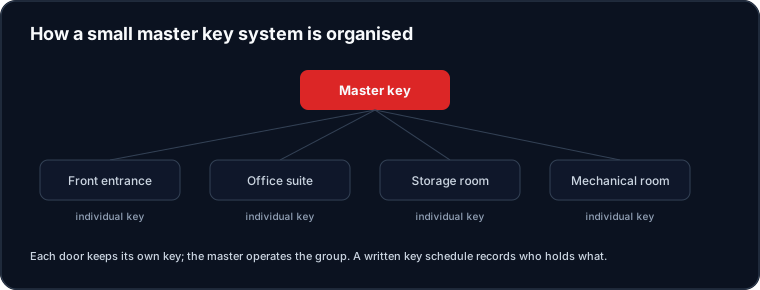
A master system is convenient, but it concentrates risk in the master key, so it works best when key holders are documented, keys are collected when roles change, and the system is designed with spare capacity so it can grow without being rebuilt. If the current arrangement has drifted over the years, it can usually be reorganised in stages rather than all at once, starting with the exterior and highest-risk doors.
Common problems include a door closer that slams or no longer latches the door, a panic bar that sticks, a lever that has gone loose, a lock that binds because the frame has shifted, and a cylinder worn from constant use. Many closer and strike issues are adjustments. Where a component has failed, replacement is matched to the traffic the door sees and to any fire-rating or accessibility requirement that applies to that opening. Fire-rated doors in particular have to keep self-closing and self-latching hardware that meets the rating, so like-for-like replacement matters.
If an exit door does not close and latch on its own, it is both a security gap and, in many cases, a code problem. It is worth reporting even when the door still opens normally.
Aluminium storefront doors use their own family of hardware: mortise or bored cylinders in a narrow stile, hook bolts and deadlatches, pivot hinges and overhead concealed closers. Because the stile is narrow, the parts are specific and worth identifying correctly before ordering. Worn pivots and a sagging door are a frequent cause of a storefront lock that has become hard to operate, and the fix is often the pivot and the alignment rather than the lock.
For property managers, the practical goal is a key system that survives tenant turnover: exterior and common-area doors on a controlled keyway, tenant spaces rekeyed between occupants, and a schedule that records every change. When a unit changes hands, rekeying that unit is a small, contained job. When the building's core keyway has been copied widely over the years, restoring control is a larger project that is normally staged, prioritising the doors that protect the most.
Scheduling is arranged by phone based on the site and the request. The client's phone line is listed as open 24 hours, and work that cannot happen during business hours is planned for a time that suits the operation. Any pricing is explained before work begins and confirmed once the hardware has been inspected in person.
Describe the site on the contact page or by phone. Related pages cover rekeying, lock repair and lock installation.
Most commercial key problems are not really about locks; they are about record-keeping. A system drifts when keys are issued without being written down, when they are not collected as roles change, and when copies are made outside the business. The practical fixes are a single written schedule that lists every door and every key holder, a rule that keys are signed for and signed back, and, where duplication is a concern, a keyway that is not stocked at every counter. Rekeying resets the hardware; the schedule is what keeps the reset meaningful.
For a business, the constraint is usually time rather than difficulty. Rekeying a dozen doors is straightforward, but doing it without leaving an entrance unsecured or interrupting trade takes sequencing: exterior and high-traffic doors first, interior and low-risk doors as time allows, and a temporary arrangement for any door that has to stay usable during the change. That plan is worked out with your authorized contact before the visit.
If the property is leased, the lease often specifies who owns the hardware and the keyway and who must approve changes. Fire-rated openings have a label on the door edge or frame that identifies the rating, and replacement hardware has to match it. If the building has an existing master key system, any bitting or schedule information from the original installer makes additions far simpler. Bringing whatever you have to the first visit saves a second one.
Fast Locksmith Service travels to the customer and does not run a public walk-in shop, so the first contact is a phone call or the contact form rather than a counter visit. On the call you describe the lock, the door, the key or the vehicle and what changed; coverage is confirmed against your street or nearest intersection; and the likely category of work and the factors affecting its cost are discussed. A firm recommendation and a firm price still depend on the technician seeing the hardware, because the same symptom often has more than one cause.
Every access job requires proof that you own, occupy or are authorized to control the property or vehicle. For a home that is usually identification matching the address; for a rental, a lease or a manager's confirmation; for a business, an authorized contact; for a vehicle, ownership documentation. This is routine, it protects everyone, and a locksmith who is willing to skip it is one to be cautious about.
Wherever the lock allows, it is opened or serviced without damage: picking, bypass tools, and decoding leave the hardware usable afterwards. Drilling is a last resort for a seized or hardened lock, or one that is already broken, and the technician explains that it is next and that the lock will be replaced before doing it.
For planned work, a few photographs of the whole door and both faces of the hardware help the technician arrive prepared, and clearing the space around each door speeds the job. Afterwards, the technician checks that bolts throw fully with the door open and closed, that keys turn without effort, and that strike screws are tight in solid material, and explains anything that may need a further small adjustment as an older door continues to move with the seasons. The client's phone line is listed as open 24 hours, and any pricing is confirmed before work begins.
Often, when cylinders and keyways are compatible. A walk-through confirms which locks can share a key and which need new hardware.
Yes. An authorized contact should be available to approve access and any hardware changes.
Scheduling is arranged by phone based on the site and the request.
A firm price depends on inspecting the work. The factors that affect it are how many locks or doors are involved, the type and condition of the hardware, whether any parts are needed, and the access at the site. Any pricing is explained on the call in general terms and confirmed before work begins; if an unexpected condition changes the picture once a lock is apart, that is explained before anything else is done.
In most cases, yes, when the hardware is standard and no special-order part is required. Where a part has to be sourced, the technician explains that and arranges a return visit.
Then that is what you are told. If you ask for a rekey but the lock is worn out, or for a replacement when a small adjustment would fix it, the technician explains the difference and the reasoning before any work.
Call and tell us what is happening. The technician reviews the lock, door, key or vehicle and explains the options before any work begins.