
Mobile locksmith · Atlanta service-area business
Replacement house, business and car keys, including transponder and remote keys, cut and programmed to your existing locks or vehicle.
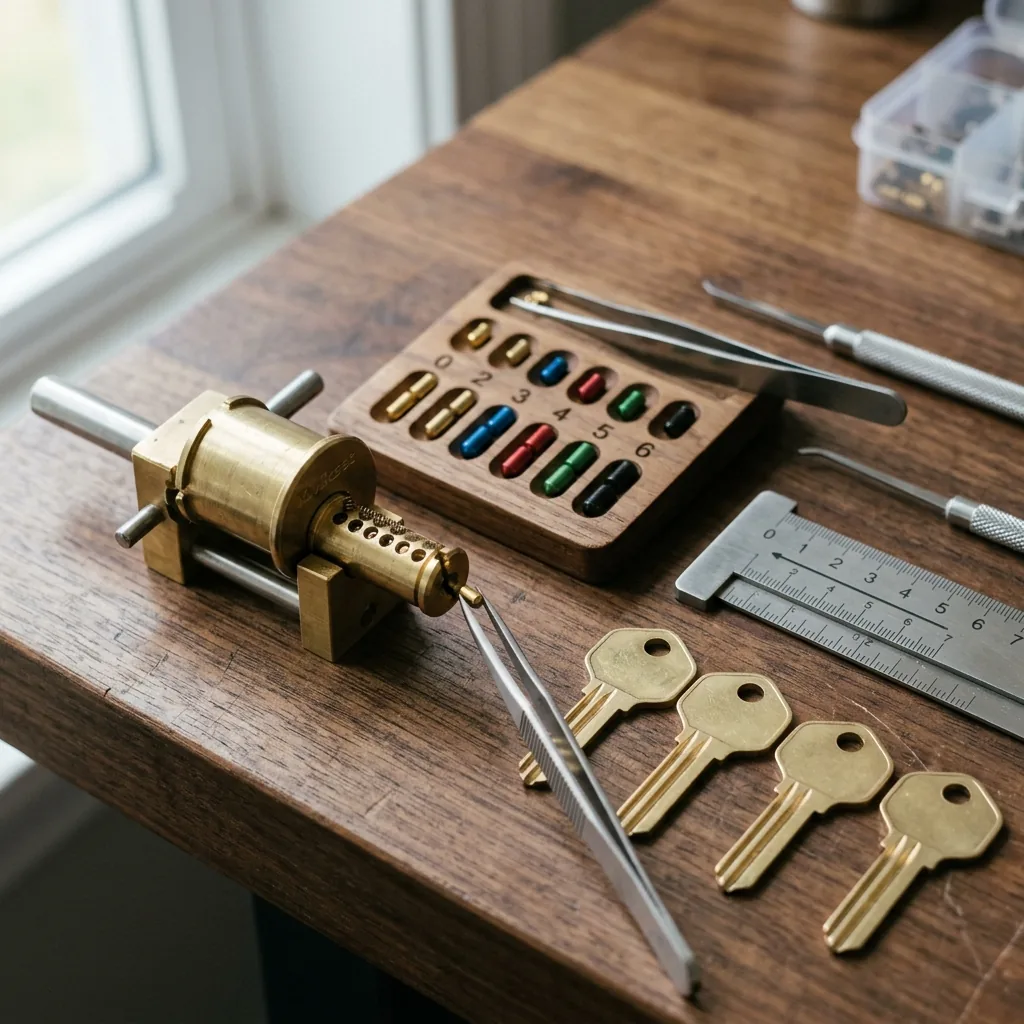
Keys are cut to your existing cylinder. If a key is worn, comparing it against another copy shows whether the key or the lock is the problem.
Replacement depends on the year, make and model and the key type. Transponder keys are programmed to the vehicle; proof of ownership is required.
If a lost key could be linked to your property, rekeying is the safer step so the missing key no longer works.
Replacement keys for a home or business are cut to your existing cylinder, either from an original or, for many locks, by reading the lock directly. If the key you are copying is worn, the copy inherits that wear, so it is worth cutting from the best original you have. Two keys that both stick usually mean the cylinder rather than the keys, which is a repair question rather than a cutting one, covered on the lock repair page.
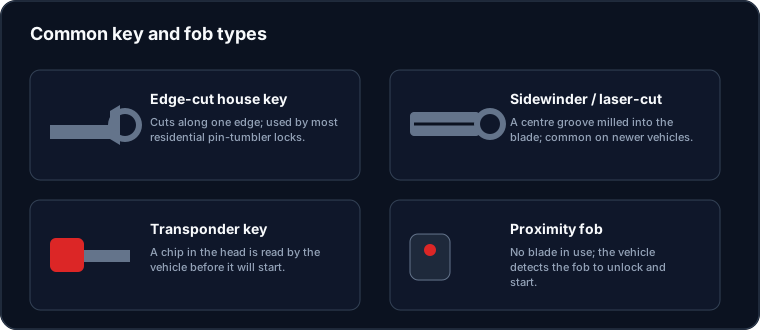
Whether a replacement car key can be produced, and how, depends on the year, make and model. An older vehicle may take a simple cut key. A newer one needs a transponder key programmed to the immobiliser, or a proximity fob paired to the car. Some vehicles allow on-site programming; some are dealer-only. This is confirmed on the call so there are no surprises during the visit, and proof of ownership is required. Fuller detail is on the car locksmith page.
If a key is simply worn or you want a spare, replacement is straightforward. If a key is lost and could be linked to your property or vehicle, cutting another copy of the same key does not restore control, because the lost key still works. In that case rekeying the affected locks, or re-pinning a vehicle lock where possible, is the step that matters.
The least expensive time to deal with keys is while you still have a working one. A spare cut today is a small job; recovering from no key at all is a much larger one, and for some vehicles it means a tow.
Some keyways are restricted, meaning blanks are controlled and copies require authorization from the keyway owner, often a landlord, a builder or an institution. If your key is stamped "do not duplicate" that is a request rather than a legal control, but a genuinely restricted keyway cannot be copied without the paperwork. High-security cylinders also often add physical protection against picking and drilling, which is a separate benefit from the key control. Bring whatever documentation you have.
Keys are not only for doors. Padlocks can often be picked open and re-keyed or replaced; a cluster mailbox lock is usually a small cam lock that can be replaced and new keys issued, sometimes with the postal service's involvement for the master; desk, cabinet and file locks use standard cam and tubular formats that can be matched from a code stamped on the lock face.
Related pages: car locksmith, rekeying and residential locksmith.
Many locks carry a code, on the cylinder face, on the lock body, or on the original key, that records the exact cut depths. Where a code is available and legitimate to use, a key can be cut to it precisely without an original present, which gives a better result than copying a worn key. Furniture, cabinet, mailbox and padlock locks very often use this system. If you have any paperwork from when a lock was bought or a safe was supplied, the code may be in it.
A copy is only as good as the key it is cut from and the machine it is cut on. A copy of a copy of a worn key eventually stops working in the lock even though it looks right. If your keys have become unreliable, the fix is to cut fresh keys from the best original, or to have the lock decoded and keys cut to the correct depths, rather than making yet another copy.
Whenever keys are cut, note how many now exist and who holds them. That record is what lets you decide, if one goes missing later, whether a rekey is warranted. It is a two-minute habit that turns a vague worry into a clear decision.
Know what the key operates, whether you have a working original, and, for a vehicle, the year, make and model and how many keys are lost. Check the key and the lock for any stamped code or a restricted-keyway marking, and gather any paperwork from when the lock or vehicle was supplied. If the key is lost rather than worn, be ready to discuss rekeying rather than only cutting a copy, because a copy of a lost key does not restore control.
House, business and vehicle keys are cut to your existing locks, and vehicle keys with a chip or fob are programmed to the car; what is possible depends on the year, make and model. A worn key can be re-cut from a better original or from a code. A lost key that could be linked to your property is a reason to rekey rather than only to copy, because the lost key still works.
Over years, a household's keys drift: copies are made from copies, one key becomes the "good" one everyone borrows, and a few no longer turn smoothly. The reset is simple. Have fresh keys cut from the best original, or have the lock decoded and keys cut to the correct depths, then label how many now exist and retire the worn ones. If the exterior doors are not already keyed alike, that is the moment to do it, so one reliable key runs the house and the spares are genuine spares rather than the three that happen to still work.
Fast Locksmith Service travels to the customer and does not run a public walk-in shop, so the first contact is a phone call or the contact form rather than a counter visit. On the call you describe the lock, the door, the key or the vehicle and what changed; coverage is confirmed against your street or nearest intersection; and the likely category of work and the factors affecting its cost are discussed. A firm recommendation and a firm price still depend on the technician seeing the hardware, because the same symptom often has more than one cause.
Every access job requires proof that you own, occupy or are authorized to control the property or vehicle. For a home that is usually identification matching the address; for a rental, a lease or a manager's confirmation; for a business, an authorized contact; for a vehicle, ownership documentation. This is routine, it protects everyone, and a locksmith who is willing to skip it is one to be cautious about.
Wherever the lock allows, it is opened or serviced without damage: picking, bypass tools, and decoding leave the hardware usable afterwards. Drilling is a last resort for a seized or hardened lock, or one that is already broken, and the technician explains that it is next and that the lock will be replaced before doing it.
For planned work, a few photographs of the whole door and both faces of the hardware help the technician arrive prepared, and clearing the space around each door speeds the job. Afterwards, the technician checks that bolts throw fully with the door open and closed, that keys turn without effort, and that strike screws are tight in solid material, and explains anything that may need a further small adjustment as an older door continues to move with the seasons. The client's phone line is listed as open 24 hours, and any pricing is confirmed before work begins.
For many locks and vehicles, yes, by reading the lock or the vehicle. It is confirmed by phone first.
If the key could be traced to your home or business, rekeying is recommended so the lost key stops working.
Some restricted keyways require authorization from the keyway owner. Bring any documentation you have.
A firm price depends on inspecting the work. The factors that affect it are how many locks or doors are involved, the type and condition of the hardware, whether any parts are needed, and the access at the site. Any pricing is explained on the call in general terms and confirmed before work begins; if an unexpected condition changes the picture once a lock is apart, that is explained before anything else is done.
In most cases, yes, when the hardware is standard and no special-order part is required. Where a part has to be sourced, the technician explains that and arranges a return visit.
Then that is what you are told. If you ask for a rekey but the lock is worn out, or for a replacement when a small adjustment would fix it, the technician explains the difference and the reasoning before any work.
Call and tell us what is happening. The technician reviews the lock, door, key or vehicle and explains the options before any work begins.