
Mobile locksmith · Atlanta service-area business
A locked door is not an emergency until you make it one. Work through these steps before forcing anything.
It is easy to fixate on the door you always use. Walk the whole exterior. A back door, a side door or an unlatched window is faster and cheaper than any other option.
Shouldering a door or prying the frame usually costs more than the lockout would have. Bent frames, cracked jambs and damaged weatherstripping all outlast the moment of frustration.
A partner, a neighbor, a family member or a landlord with a spare will often be the quickest resolution. A property manager may be required to authorize entry for a rental.
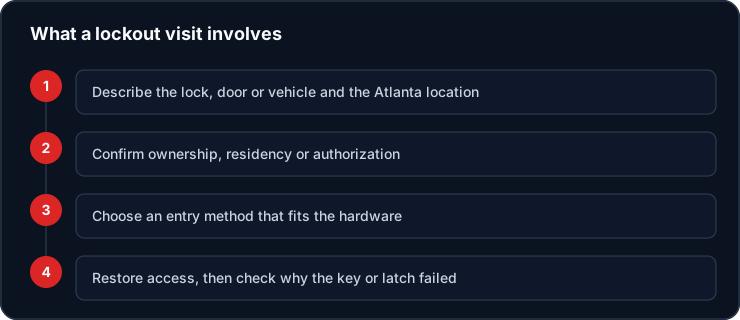
Have your address ready, be prepared to show identification or proof of residency, and describe the lock: a knob, a deadbolt, a keypad, or a smart lock. That helps the technician arrive with the right approach.
If the latch closed on its own, a door closer or a worn spring may be the reason. If the key failed, compare it with a spare to see whether the key or the lock is worn.
A locked door feels like an emergency and usually is not one. The mistakes people make when locked out, forcing the door, breaking a window, prying the frame, tend to cost far more than the lockout itself and can turn a quick fix into a repair. A few minutes of calm checking first is almost always worth it.
It is easy to fixate on the door you always use. Walk the whole exterior. A back door, a side door, a garage service door or an unlatched ground-floor window is faster, free and does no damage. If you have a garage with power out, many openers have a manual release cord that lets you lift the door by hand from inside; from outside, some have an emergency release kit through the top panel.
Shouldering a door or levering the frame usually damages the jamb, the weatherstripping or the door itself, and a bent frame often will not seal or lock properly afterwards. Breaking a small window near the handle to reach in is also a poor trade: the glass, the callout to replace it, and the security gap until it is fixed add up to far more than a locksmith visit. Prying at a deadbolt with a screwdriver typically just damages the finish and the door edge without moving the bolt.
A partner, a housemate, a family member, a trusted neighbour or a nearby friend with a spare is often the quickest resolution. For a rental, the landlord or property manager may hold a key and, in many cases, is the person who has to authorize entry anyway. If you use a lockbox or a smart lock with backup codes, now is when that pays off.
This is the argument for a spare key held off-site, with someone you trust, before you ever need it. A spare in a neighbour's kitchen drawer has resolved a lot of lockouts for the cost of cutting one key.
Have your address ready and be prepared to show that you live there: identification matching the address, a lease, or a piece of mail. For a rental you may need the manager to confirm. Describe the lock so the technician arrives with the right approach: a knob, a deadbolt, a lever, a keypad, or a connected lock, and whether the door is wood, fibreglass or steel. Ask about pricing on the call; it should be explained before anyone starts work.
Most residential locks are opened without damage by picking or by a bypass tool. Drilling is a last resort for a seized or hardened lock and means the lock is replaced afterward; a technician tells you before it comes to that. There is a fuller explanation on how a locksmith opens a locked door.
A lockout usually has a reason. If the door latched behind you on its own, a storm-door closer or a worn latch spring is the likely cause and it will happen again until it is addressed. If your key failed in the lock, compare it against a spare: a worn key can be re-cut, while two worn copies point to the cylinder. If a key is unaccounted for, rekeying the locks it fits is how you make sure it cannot be used. The lockout service page covers what a visit involves.
If your only way in is through an attached garage and the power is out, the opener will not run, but almost every opener has a manual release: a red cord hanging from the trolley that disconnects the door from the motor so you can lift it by hand from inside. From outside, some garages have an emergency release kit, a small lock on the top panel with a cable that pulls the same release. If neither is fitted and the garage is your only route, that is a reasonable time to call for help rather than to force the house door.
If you rent, find out now how an after-hours lockout is handled: whether the property manager holds a key, whether there is an on-call number, and whether they authorize a locksmith or send someone. Many leases make the landlord the party that has to approve entry, so a locksmith may not be able to let you in without that call regardless of your identification. Knowing the process saves a long wait later.
A lockout is a small job. Be cautious of a quote that climbs sharply once someone arrives, of a refusal to give any pricing on the phone, or of a technician who reaches for a drill on a standard residential lock without explaining why. A fair locksmith confirms your authorization, describes the method, gives you a price to agree before starting, and opens most home locks without damage.
The single best step is a spare key held off-site with someone you trust, arranged before you are ever locked out. After that: keep the deadbolt thrown so a plain latch cannot be slipped, adjust or disconnect a storm-door closer that keeps latching the main door behind you, and deal with a lock that has been getting harder to turn before it strands you. A keypad lock on the everyday door removes the physical-key failure entirely.
A very common call is a child who has locked a bedroom or bathroom from the inside, or an older relative who cannot work the latch. Interior privacy sets are designed to be overridden from outside in exactly this situation: there is a small hole in the outside knob, and a narrow tool, a straightened paper clip on some models, or the special key that came with the set releases the latch. It is worth locating that key now and taping it above the door frame, and worth knowing that these locks are not a security barrier and open in seconds.
The reason a lost key is hard to reason about is usually that nobody knows how many copies exist. A two-line note kept somewhere sensible, how many keys were cut and who holds each, turns a vague worry into a clear decision: if a key on that list goes missing, you rekey; if it is not on the list, it was probably never yours to worry about. It is a small habit that pays off exactly once, at the worst possible moment, which is when it matters.
The same principle applies: do not force it. A slim-jim used by someone unfamiliar with a modern door can catch wiring, the airbag module or the latch linkage, and the repair costs far more than the lockout. If a child or a pet is shut inside and it is hot or the situation is becoming dangerous, call 911 first. Otherwise, a locksmith opens the door with tools made for that vehicle, and it helps to have the year, make and model ready and to say whether the key is visible inside, in the trunk, or unknown.
A few signs separate a straightforward local locksmith from an operation to avoid. A fair locksmith gives you a general idea of pricing on the phone and a firm price to agree before starting work, rather than a low number that climbs sharply once someone arrives. They confirm your authorization to request the work. They default to opening a lock without damage and treat drilling as a stated last resort on a standard residential lock, not a first move. They recommend the work the hardware actually needs, which sometimes means talking you out of a replacement you asked for.
It is reasonable to ask, on the call: how will you open it, roughly what will it cost, and what happens to the lock afterward. The answers tell you most of what you need to know. A business with a real local service area, a published phone number and pages that explain how the work is done, rather than a wall of city names and superlatives, is generally a safer choice than a listing that exists only to capture a search.
If you are weighing a decision rather than dealing with a lockout, describe your specific situation on the contact page or by phone first. The likely answer is usually clear before anyone is on site, and it is confirmed once the hardware is inspected.
Call and tell us what is happening. The technician reviews the lock, door, key or vehicle and explains the options before any work begins.