
Mobile locksmith · Atlanta service-area business
Grade, bolt throw, strike reinforcement and key control matter more than brand. A short guide before you buy.
A deadbolt has to match your door's thickness, the bore diameter and the backset (the distance from the edge of the door to the center of the hole). Most residential doors are standard, but measure before ordering.
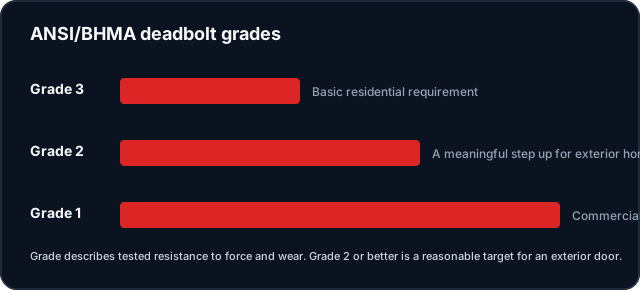
ANSI/BHMA grades run 1 to 3. Grade 3 meets basic residential requirements; Grade 2 is a meaningful step up; Grade 1 is commercial-level. For an exterior home door, Grade 2 or better is a reasonable target.
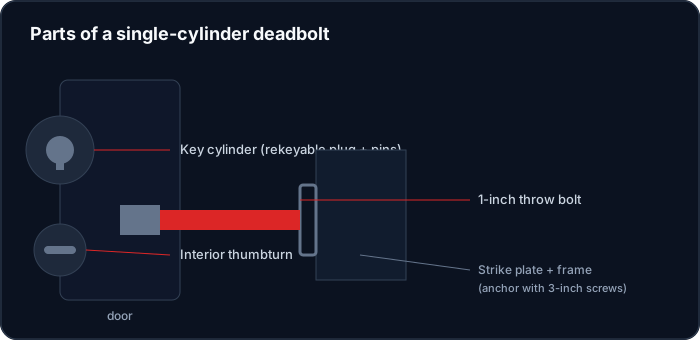
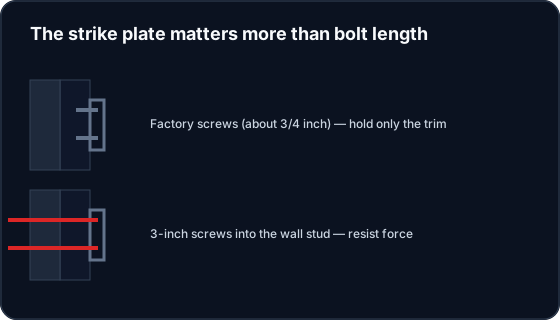
A one-inch bolt throw is standard. The bigger security gain is the strike: a reinforced strike plate with three-inch screws into the framing resists a kick far better than the short screws that ship in the box.
A keyed deadbolt is simple and needs no power. A keypad removes the physical key but needs code discipline and batteries. A smart lock adds remote control and logs, with more to maintain. Pick the one that matches how your household actually operates.
If you rekey or replace, consider keying all exterior doors alike so one key works everywhere. Keep track of how many copies exist.
Before grade, brand or finish, a deadbolt has to fit the door. Three measurements matter: the door thickness, the diameter of the bore (the large hole, usually about 2 1/8 inches), and the backset, which is the distance from the door edge to the centre of that bore, almost always 2 3/8 or 2 3/4 inches on a home. Most doors are standard, but solid-timber, custom and very old doors are not always, and a lock that does not fit will never operate smoothly.
Deadbolts are tested and graded by ANSI and BHMA on a scale from 3 to 1. Grade 3 meets a basic residential standard. Grade 2 is a meaningful step up in the cycle and strength testing. Grade 1 is commercial-level. For an exterior door on a home, Grade 2 or better is a reasonable target; the difference in price between a low Grade 3 and a solid Grade 2 is usually small compared with what the lock is protecting.
A deadbolt should have a bolt that throws a full inch into the frame; a bolt that only half-engages because of poor installation or misalignment is barely better than a spring latch. But the larger security gain is not the bolt, it is the strike. The plate that ships in the box is held by short screws that only reach the door trim. Replacing them with three-inch screws that pass through the jamb into the wall framing, ideally with a reinforced strike box, is the single most cost-effective thing you can do to help a door resist force.
A keyed deadbolt is simple, inexpensive to service, and needs no power; the trade-off is managing physical keys. A keypad deadbolt removes the key and lets you give out codes, at the cost of battery changes and code discipline. A connected deadbolt adds app control, temporary codes and a log, and adds firmware, batteries and a network to maintain. None is best in the abstract; the right one matches how your household actually operates. A common approach is a connected or keypad lock on the everyday door and a plain keyed deadbolt on a second door as a fallback.
On a door with glass in or beside it, a standard single-cylinder deadbolt can be reached by breaking the glass and turning the thumbturn. A double-cylinder deadbolt needs a key on both sides, which removes that risk but means you cannot get out without a key. Weigh that against fire escape before choosing one, and check local code.
If you are fitting or replacing several locks, have them keyed alike so one key runs the house, and consider a keyway that is not copied at every hardware counter if uncontrolled duplication is a concern. Keep a simple record of how many keys exist and who has them; that record is what makes it possible to know, later, whether a rekey is needed.
Related pages: lock installation, lock repair and rekeying.
Beyond security, a lock has to suit the door in ordinary ways. Finish should match or deliberately contrast with the other hardware; common options hold up differently to weather, with living finishes changing over time by design. Handing matters for levers and handlesets: the lock has to be ordered or set for the way your door swings. If you are replacing several locks, matching the finish and keying them alike keeps the house consistent and simple to live with.
A well-chosen deadbolt installed poorly is a mediocre deadbolt. The bolt has to throw its full length without being forced, the cylinder has to sit square so the key turns freely, the strike has to be positioned so the bolt enters cleanly, and the long screws have to actually reach solid framing rather than stopping in the jamb. On a door that has settled, alignment work may be needed first so the new lock operates properly from the start.
If you go with a connected or keypad deadbolt, check that it fits your door thickness and bore, that it has a mechanical key cylinder as a backup, and that the backup cylinder can be keyed to match your other locks. Plan for battery changes on a schedule rather than waiting for the low warning, and decide whether you want it on every door or just the everyday one with a plain keyed deadbolt elsewhere.
For most Atlanta homes, a reasonable target is a Grade 2 or better single-cylinder deadbolt with a one-inch bolt, a deadlocking latch on the accompanying knob or lever, a reinforced strike with three-inch screws into the stud, and all exterior doors keyed alike. That is a modest cost, it closes the common weak points, and it is worth confirming that an existing installation actually meets it rather than assuming.
The frequent errors are predictable. Buying on finish and brand rather than grade. Assuming a heavy, expensive-looking lock is a high grade when it may not be tested at all. Fitting a strong deadbolt and leaving the factory strike screws in place, which wastes most of the benefit. Choosing a double-cylinder deadbolt on a bedroom-level door without thinking about getting out in a fire. And putting a connected lock on every door, then discovering that a flat battery or a network problem means a scramble for the backup key. A short conversation before buying usually heads all of these off.
You should be able to lock and unlock the deadbolt with one finger on the thumbturn and a light turn of the key, with the door both open and closed. The bolt should disappear fully into the frame, not stop short. There should be no need to lift, push or pull the door to make it turn. The exterior cylinder should sit flush and square, not tilted. And the strike screws should be long ones that you can feel bite into solid wood behind the jamb. If any of that is not true, the job is not done, whether it was a locksmith or a previous owner who did it.
On an older Atlanta home, a new deadbolt sometimes will not sit right because the existing bore is a non-standard size, the door is thicker or thinner than modern hardware expects, or a previous lock left an oversized hole. None of these prevents a good result, but they mean the fit has to be checked and, occasionally, a conversion plate or a different model used. It is the reason measurements come before ordering rather than after.
Some finishes are marketed as lifetime and stay bright; others are living finishes designed to change and patinate with handling and weather, which is a look some people want and others are surprised by. On a door that gets direct afternoon sun and Atlanta's summer humidity, a plated finish on a budget lock can also wear through at the thumbturn and the keyway sooner than expected. If appearance over time matters to you, ask which category a finish is in before you buy, rather than after it has started to change.
A few signs separate a straightforward local locksmith from an operation to avoid. A fair locksmith gives you a general idea of pricing on the phone and a firm price to agree before starting work, rather than a low number that climbs sharply once someone arrives. They confirm your authorization to request the work. They default to opening a lock without damage and treat drilling as a stated last resort on a standard residential lock, not a first move. They recommend the work the hardware actually needs, which sometimes means talking you out of a replacement you asked for.
It is reasonable to ask, on the call: how will you open it, roughly what will it cost, and what happens to the lock afterward. The answers tell you most of what you need to know. A business with a real local service area, a published phone number and pages that explain how the work is done, rather than a wall of city names and superlatives, is generally a safer choice than a listing that exists only to capture a search.
If you are weighing a decision rather than dealing with a lockout, describe your specific situation on the contact page or by phone first. The likely answer is usually clear before anyone is on site, and it is confirmed once the hardware is inspected.
Call and tell us what is happening. The technician reviews the lock, door, key or vehicle and explains the options before any work begins.